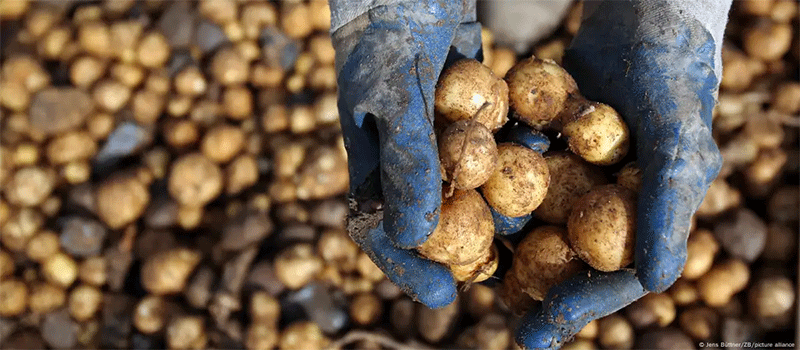
A combination of expanded acreage and ideal growing conditions is set to deliver Germany its most significant potato harvest since 2000. According to preliminary figures from the German Ministry of Agriculture, the 2025 harvest is projected to reach 13.4 million tonnes. This represents a 5.3% increase over last year’s already strong season and a substantial 17% rise above the multi-year average. The surge is attributed to a 6.7% expansion in planted area, now totaling 301,000 hectares, and a high average yield of approximately 44 tonnes per hectare, bolstered by favorable weather compared to previous years.
However, this bounty presents a immediate challenge for producers. The market is experiencing a classic supply-demand imbalance. Farmers are currently receiving about one-third less for new-crop potatoes compared to 2024. This price pressure has already reached consumers, with supermarket prices in August 2025 being roughly 15% lower than the same period last year.
Beyond the current market fluctuation, the potato’s strategic importance is growing. Globally, it remains the fourth most important staple crop after rice, wheat, and corn. Recent consumption trends in Germany underscore this: per capita consumption has jumped to 63.5 kilograms, nearly an eight-kilogram increase from previous years. Of this, 25.5 kg are consumed as fresh potatoes, while 38 kg are processed into products like fries, chips, and salads.
The potato’s value proposition is strengthened by its resource efficiency, a critical factor in an era of climate change. According to the Water Footprint Network, it takes approximately 130 liters of water to produce one kilogram of potatoes. This is dramatically lower than other staples: wheat requires about 1,400 L/kg, rice 2,500 L/kg, and beef nearly 17,000 L/kg. This low water footprint, combined with high nutritional density, makes it a cornerstone for future food security.
To secure this future, German science is looking beyond the current harvest. The recently launched project “Pommorow” (Potato Tomorrow) aims to genetically characterize all 6,357 potato accessions held in the German gene bank. This groundbreaking research, involving five leading scientific institutes and three plant breeding companies, seeks to identify traits vital for sustainable cultivation, such as resistance to pests, lower fertilizer requirements, and enhanced drought tolerance. As climate volatility increases, unlocking this genetic diversity is no longer a scientific luxury but an agricultural necessity.
The 2025 German potato season is a tale of two realities. In the short term, a record harvest creates a buyer’s market, pressuring producer profitability. In the long term, however, the potato’s inherent efficiency and ongoing genetic research solidify its role as a resilient and sustainable crop. For farmers and agronomists, navigating this dichotomy—managing present-day surpluses while investing in future-proof varieties—will be the key to leveraging the potato’s full potential in a changing world.
