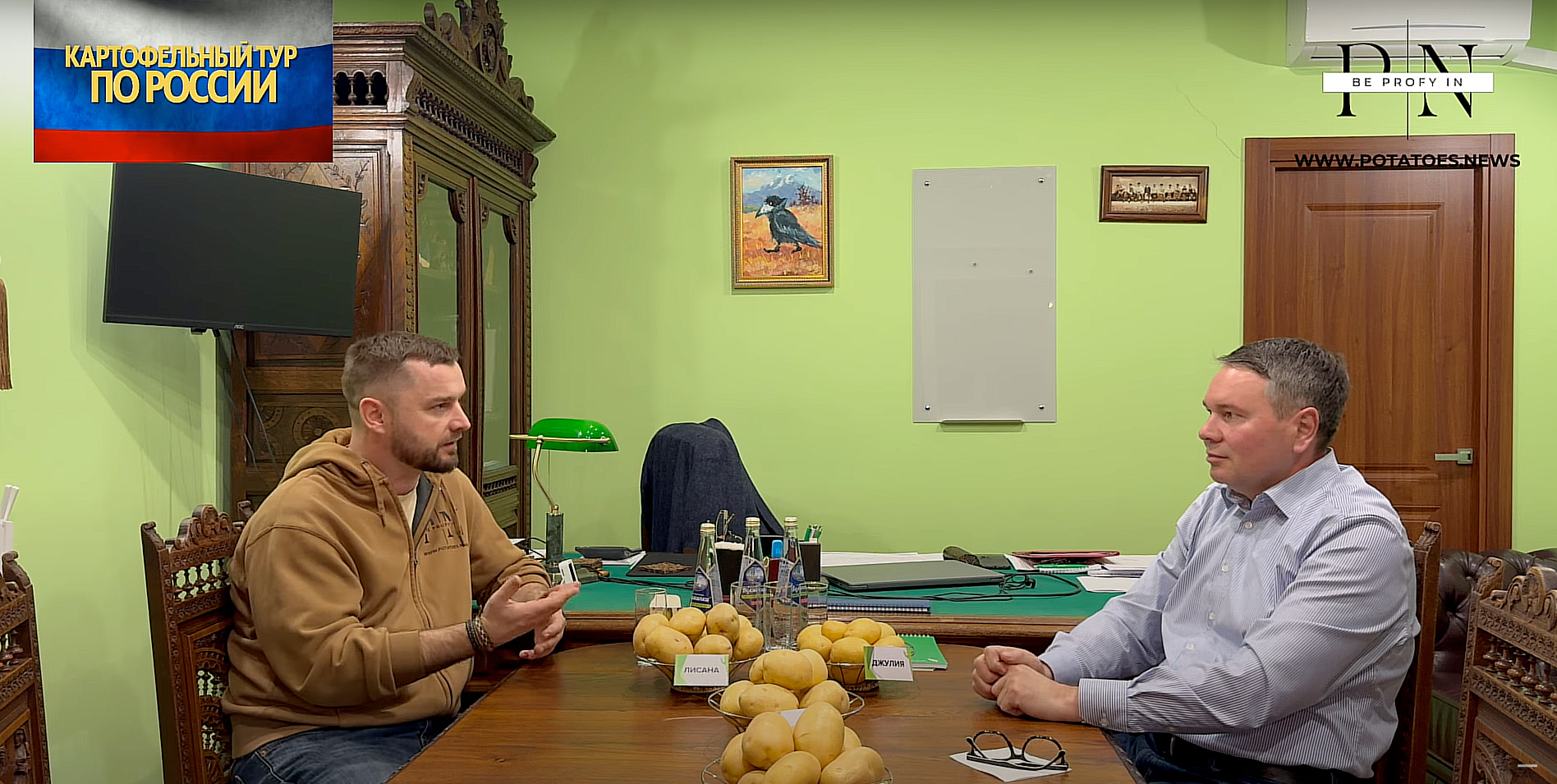
Russian potato breeding has made a qualitative leap in recent years, but the toughest challenge isn’t creating varieties—it’s getting them to market at home and abroad. In a conversation with Vladimir Molyanov, head of the Molyanov Agro Group (MAG), the expert stresses that the sector needs a coordinated “push”: support for promotion and registration, producer consolidation, and guaranteed sales channels.
Promotion hits the wall of registration—and budgets
“We’ve created new varieties, but it turned out that promoting them costs a lot,” says Molyanov.
Export ambitions collide with different country requirements—from Mongolia and Central Asia to Ireland and India. While the state calls for more exports, companies must pour significant funds into registration and marketing; without that, “going outside” is unrealistic.
MAG as a bridge between farms and the market
MAG was conceived to help growers stop “producing for the warehouse” and instead go to market with a curated portfolio of varieties. The mix includes both free and licensed varieties matched to real farm conditions: soils, staffing, storage technologies.
The key value is guaranteed off-take: if a lot doesn’t sell in the Samara region, it may be needed in Kazakhstan, Siberia, or European Russia. Matching demand across geographies keeps stock moving and turns harvests into cash.
Breeding is a marathon that needs scale
Unlike cereals with 8–15 key traits, potato varieties have 40–50+ traits, plus storage and market parameters. Cycles are long: a variety that looks perfect today may be irrelevant five years later. Mistakes are inevitable—and you need resources to absorb them.
European practice suggests that to fund R&D and new-variety launches sustainably, a company should sell around 30,000 tonnes of seed potatoes annually. State programs gave a useful initial impulse; now the priority is self-financing breeding: earn some—reinvest some.
Regional consolidation lifts product quality
In the Samara region, MAG and peers bet on consolidation: fewer elbow-to-elbow rivalries, more joint work on quality, stability, and out-of-region sales. This strengthens the whole chain—from field and storage to contract and logistics.
People, continuity, and management accents
A strong, committed team underpins resilience. MAG highlights succession: Vladimir works with his son Ilya.
“I’m a man of action: I run first, think later. He’s the opposite—calculates first, then runs,” Molyanov admits.
This pairing—strategic calculation + entrepreneurial impulse—supports more balanced decisions.
What’s next
No “imperial ambitions,” but a clear sense of scale: grow volumes, hold quality, invest in breeding, and widen geography after clearing regulatory hurdles abroad. The goal is not only to create Russian varieties, but to make them demanded—at home and in export markets.
“Any variety can find its buyer—if you ensure proper matching, registration, and market access. Then warehouses become waypoints, not dead ends.”