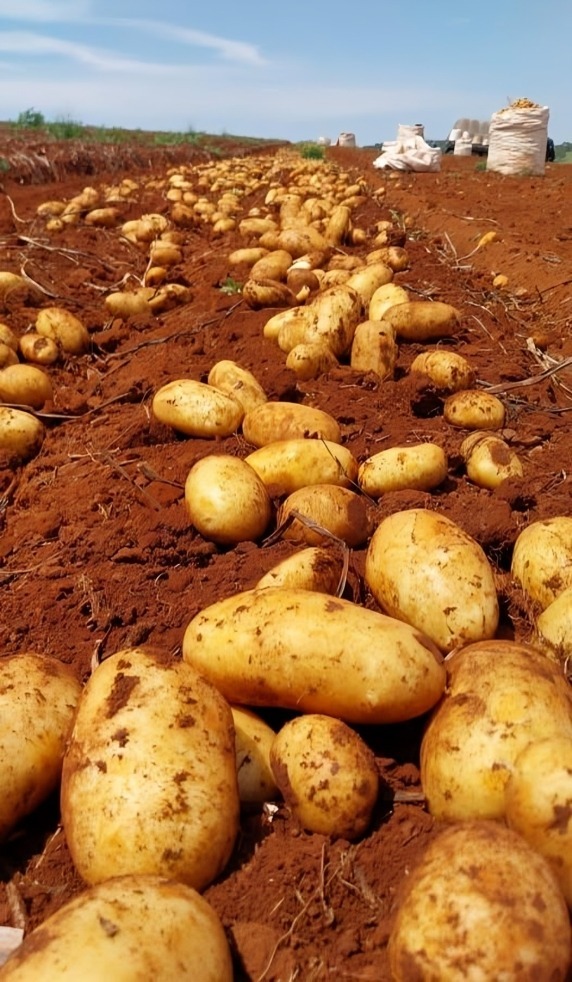
Brazil’s potato market has closed the week with notably higher prices, driven by persistent rainfall that once again disrupted harvesting, logistics and overall supply. For producers and traders, this marks yet another climate-related challenge in a season already characterized by volatility.
The rains affected not only volumes but also the quality of potatoes arriving at wholesale markets, tightening availability of premium-grade product.
How Rainfall Affected the Market
Harvest Delays and Field Losses
Constant rainfall in producing states made harvesting difficult or impossible in many areas.
Waterlogged fields increase the risk of:
- mechanical damage during harvest,
- spoilage,
- fungal issues,
- reduced shelf life.
As a result, fewer potatoes reached distribution centers.
Lower Quality on the Market
The tubers that did arrive often showed defects caused by excess moisture.
With high-quality lots scarce, premium potatoes fetched significantly higher prices.
Supply Tightening Across Regions
Key producing regions — including Minas Gerais, São Paulo and Paraná — reported inconsistent supply flows.
Wholesalers noted that many shipments were smaller than expected.
Market Reaction: Prices Move Up
Producers who managed to harvest before the heavy rainfall benefited from better prices by the end of the week.
Buyers, especially in major urban centers, faced rising quotes due to:
- reduced supply,
- the scarcity of top-grade potatoes,
- increased post-harvest losses from weather stress.
Similar patterns were reported earlier this year on Potatoes News: rainfall episodes have repeatedly led to abrupt price swings in the Brazilian potato market.
Potatoes News Analytics: Climate’s Growing Influence
The latest price rise further confirms a trend we’ve tracked across Brazil and Latin America:
Weather Now Drives Market Behavior
Frequent rain, heatwaves and irregular seasons are shaping supply dynamics more strongly than traditional market cycles.
Quality Volatility Is Increasing
Buyers and processors face greater variation in tuber size, defects and storability.
Infrastructure Gaps Amplify Climate Impacts
Producers with limited storage or drainage capacity suffer the most from recurring rains.
These challenges echo similar situations in Argentina, Mexico and Colombia, where climate factors are increasingly dictating market outcomes.
What the Coming Weeks May Bring
More Price Volatility
If rains persist or if new weather events occur, prices are likely to remain unstable.
Short-Term Opportunities for Some Producers
Growers with stored potatoes or access to mechanized harvesting have a temporary advantage.
Potential Pressure on Retail Prices
Consumers may see higher prices depending on regional supply and logistics conditions.
Conclusion
Once again, heavy rainfall has disrupted Brazil’s potato market, tightening supply and lifting prices. This recurring pattern highlights the sector’s vulnerability to climate variability and underscores the need for more resilient production and post-harvest systems.
The question facing the sector is:
Will Brazil invest in the infrastructure and climate-adaptation tools needed to reduce market volatility in future rainy seasons?
Brasil: La lluvia vuelve a afectar al mercado de la papa y la semana cierra con precios más altos.
argenpapa.com.ar/noticia/16771-