Prepared as part of the International Potato Tour (IPT).
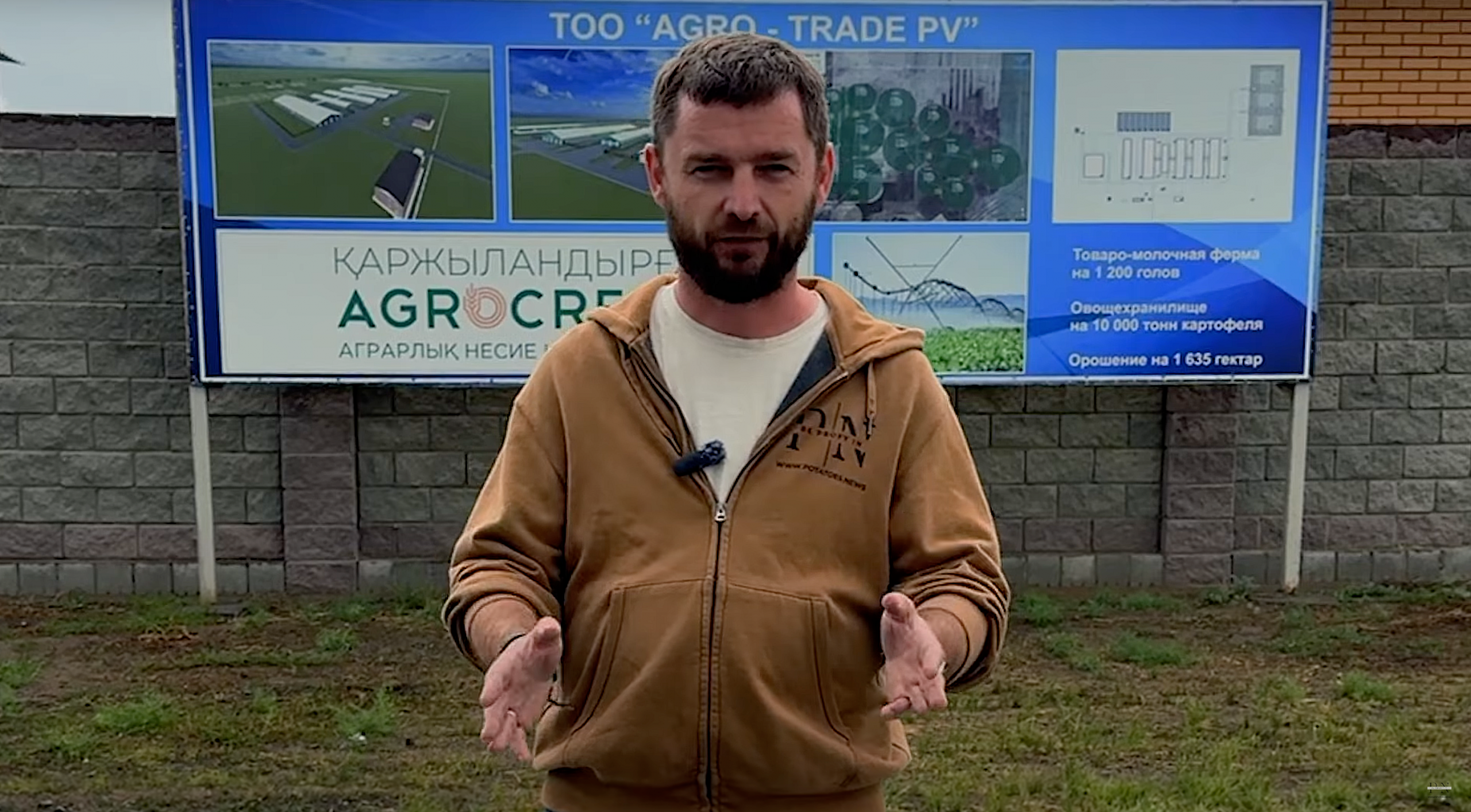
On day two of the Kazakhstan leg of the Potato Enthusiast project, together with Alexander Matvienko, Executive Director of the Union of Potato and Vegetable Growers of Kazakhstan, we visited Agrotrade BV in the Pavlodar Region. The farm focuses on seed potato production, center-pivot irrigation, and exemplary storage sanitation.
How people arrive in potatoes
The farm manager tells his story simply: from law enforcement to agribusiness. First—security at a farming enterprise, then responsibility for vegetable stores, and next a managerial role. “I wouldn’t call myself an agronomist, but I learn every day—colleagues point out what’s weak and where to strengthen. Practice is the best teacher.”
His key discovery along the way was seed generations: from elite to 1st, 2nd, 3rd reproductions—not endless “home selection,” but controlled renewal of seed material.
Climate: heat, dust storms, and hail
Farming in Kazakhstan is about contrasts. In 2024 a local storm (June 19) swept parts of Aksu and Pavlodar districts; last season brought hail and gale winds. Summer temperatures often hit +35 to +40 °C, with nights dropping to +15…+20 °C—sharp swings are common. “Something hits us every year; there’s no turning back—empty storages are behind us, and they must be filled,” the team sums up.
Why irrigation is non-negotiable
Potatoes here are grown only under irrigation: investments on rainfed vs irrigated fields are similar, but output differs roughly twofold. The Pavlodar Region relies on the Irtysh and canal networks. Reported tariffs vary; in the area you’ll hear 8–56 tenge per m³ (depending on source and location).
Fields are equipped with center pivots: ~400 m radius (≈52 ha) and up to ~710 m on larger blocks. A dedicated hydro-crew manages operations and rapid repairs. Compact geography—fields clustered around the base—keeps logistics tight.
Weed control and crop protection
On sandy soils herbicides perform more predictably than on chernozems: baseline metribuzin rates work well; the second flush is handled with selective actives (including prosulfocarb and rimsulfuron). For grasses, graminicides (e.g., Fusilade-type products) are used. A special focus is quarantine weeds like pink knapweed/bindweed: strict containment, burning of spots, and monitoring to avoid multi-year restrictions.
Managing plant stress
After wind/solar stress the farm prioritizes protecting the canopy and irrigation, adds foliar feeds, and maintains a contact-plus-systemic fungicide rotation roughly every 10 days—“no chasing.”
Storage: sanitation as a calling card
“Why is it so white in here?” — “Because cleanliness equals quality.” The store has washed floors, clean ventilation ducts, scheduled degassing and insect/rodent control. This discipline eases both intake and dispatch.
On the sorting line they practice narrow specialization by station:
- “soil only,” 2) “cut tubers only,” 3) “rot only,” 4) “final QC.”
This lifts throughput by ~10% by reducing unnecessary motions per worker. Optical sorting is under consideration, but with sand/vines in the mix manual checks remain essential.
People and responsibility to the community
About 50 people work in vegetable production during the season; extra hands join for hand-grading at harvest. Winter is busy too: machinery, yard work, dairy farm links, snow removal, moving organics. The enterprise also supports local schools and kindergartens—social responsibility in action, not just words.
What peers can take away
- Irrigation is a must: center pivots pay back over ~10 years; without water the economics don’t add up.
- Compact logistics: clustering fields around the base saves fuel, time, and nerves.
- Weed control by soil type: sandy soils respond more consistently; clean up the second flush with selectives.
- Sanitation = money: clean ducts and dispatch zones cut losses; specialized stations add ~10% throughput.
- Seed production by the book: from elite to lower reproductions—no over-stretching seed renewal.
The International Potato Tour (IPT) continues across Kazakhstan—more farms, technologies, and field practices from Pavlodar and neighboring regions are next.
Want to be the hero of our next episode or become a partner? Email i@viktorkovalev.ru or message me on WhatsApp +79614720202 or Telegram.