The global potato sector is navigating a new reality defined by climate volatility and economic pressure. Success is no longer guaranteed by maximizing yield in a good year, but by minimizing losses and maintaining stability through bad ones. This requires a fundamental shift from a reactive, crisis-management mindset to a proactive, systems-based approach to resilience. This framework encompasses four interconnected pillars: Biophysical Resilience (healthy soils, robust varieties, smart rotations), Economic Resilience (strategic contracts, disciplined cost structures), Operational Resilience (advanced storage, flexible logistics), and Human Resilience (informed decision-making, mental well-being). A 2023 report from the UN’s Food and Agriculture Organization (FAO) emphasized that climate-resilient agriculture must be built on such diversified foundations to ensure food security, noting that soil degradation alone threatens the livelihoods of millions of farmers worldwide.
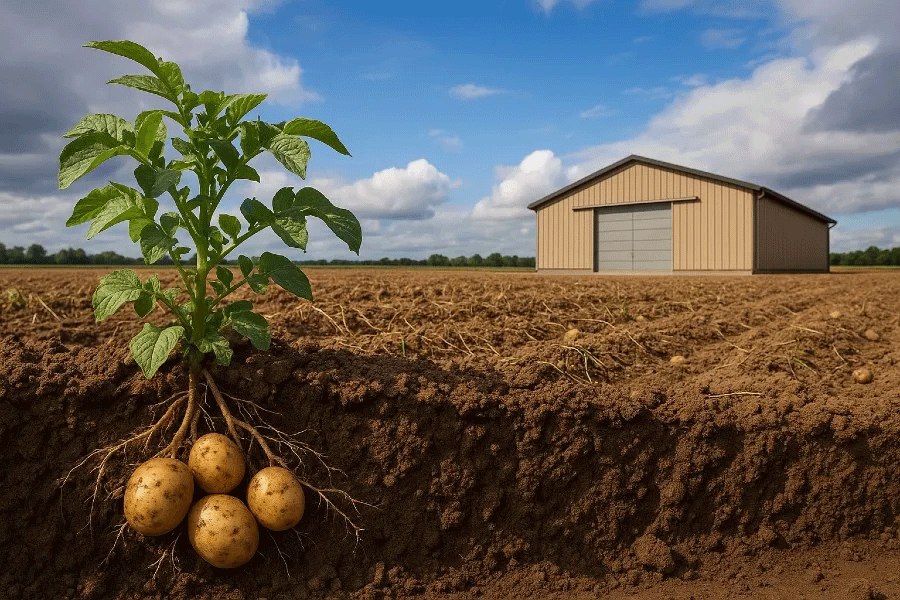
The foundation of any resilient system is soil health. Soils with high organic matter act as a built-in shock absorber, improving water infiltration during intense rainfall and enhancing water-holding capacity during drought. Research from projects like the “Soil Health Institute’s National Initiative” in the US demonstrates that practices such as multi-species cover cropping and reduced tillage can significantly increase soil organic carbon, directly contributing to yield stability. This is complemented by strategic variety selection, where traits like heat and drought tolerance are becoming as critical as yield potential. For instance, breeding programs are increasingly focusing on developing varieties with enhanced resilience to abiotic stresses, a trend documented in the journal “Potato Research,” which highlights the growing demand for clones that can maintain processing quality under thermal stress. Furthermore, modern storage infrastructure, equipped with precise climate control and backup power, transforms a potential weak link into a strategic asset, allowing growers to navigate market fluctuations and manage quality degradation from unpredictable harvest conditions.
However, resilience cannot stop at the farm gate. Economic and human factors are equally critical. Contract structures must evolve beyond simple volume-and-penalty models to include risk-sharing mechanisms for extraordinary weather events. A study on agricultural supply chains published in “Agricultural Systems” found that contracts with flexible terms and force majeure clauses lead to more stable and sustainable grower-processor relationships. Financially, stress-testing business models against consecutive poor seasons is essential for survival. Concurrently, the industry is recognizing that human capital is its most valuable asset. The chronic stress of managing a high-risk business in a volatile climate can impair judgment; therefore, investing in peer networks, advisory support, and mental well-being is not a luxury but a core component of a resilient operation.
Building a shock-proof potato business is a complex, multi-year endeavor that requires integrating agronomic science, financial acumen, and strategic planning. It demands a move away from chasing peak performance in ideal conditions and toward constructing a system that maintains a stable, profitable baseline under a wide range of stressors. The growers who will thrive in the coming decades will be those who view their enterprise as an interconnected whole, where investments in soil organic matter, climate-resilient varieties, robust storage, fair contracts, and human well-being collectively build a buffer against uncertainty. This holistic resilience is not merely about survival; it is the new foundation for sustainable profitability and intergenerational success in a rapidly changing world.