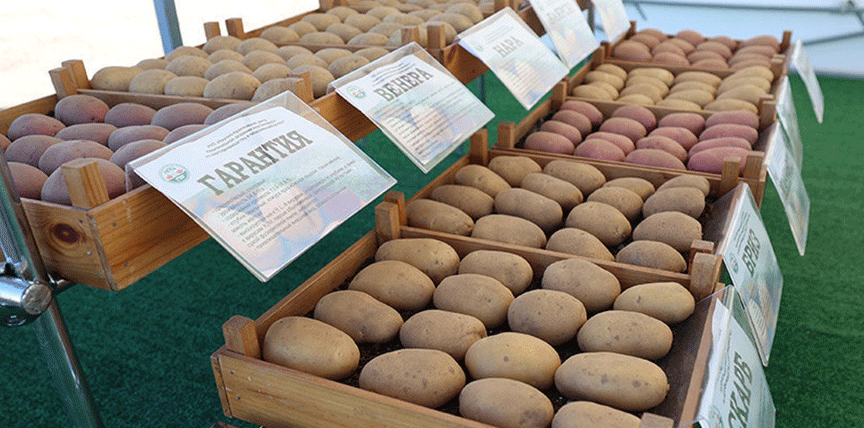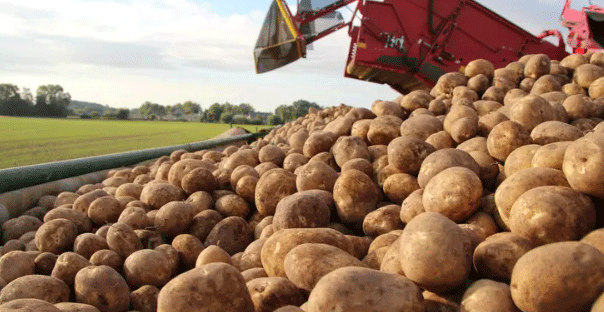
Despite being a global staple feeding over 1.3 billion people, the potato has long resisted major breeding improvements due to its complex genetics. The crop’s tetraploid nature—with four sets of chromosomes instead of the usual two—has made conventional breeding efforts incredibly challenging, slowing innovation in disease resistance, yield improvement, and climate resilience.
Now, a consortium of researchers from Ludwig-Maximilians-Universität Munich (LMU), the Max Planck Institute for Plant Breeding Research, Wageningen University, Leibniz Institute of Plant Genetics, and Xi’an Jiaotong University in China has reconstructed the complete genomes of ten historical potato varieties, dating back to the 18th century. These varieties alone represent a staggering 85% of the total genetic variation found in modern European potatoes.
Why This Matters: A Narrow Genetic Pool with Big Implications
Since potatoes were introduced to Europe from South America in the 16th century, the crop has gone through severe genetic bottlenecks. Only a limited number of varieties adapted well to European climates, and further genetic erosion occurred due to devastating diseases—most famously late blight, which caused the Irish Potato Famine in the 1840s.
The result is that modern breeding has had a shallow gene pool to work with, severely limiting progress. The findings of the recent study published in Nature now clarify that although overall diversity is limited, the differences within individual chromosomes can be surprisingly large—larger than what scientists have observed in any other domesticated plant species to date.
This means that while the potato genome might not be broadly diverse, deep diversity within chromosome copies offers significant breeding potential if properly harnessed.
A Path Forward: Faster and Smarter Potato Breeding
This breakthrough has several implications for the agricultural sector:
- Accelerated genome reconstruction: The data and techniques used by the research team allow for faster sequencing of additional potato varieties, improving the pace of future breeding programs.
- Marker-assisted selection: With clearer insights into chromosomal variability, breeders can more efficiently identify traits linked to disease resistance, drought tolerance, and yield.
- Precision breeding and gene editing: Understanding the structure of complex tetraploid genomes opens new doors for CRISPR-based breeding and other biotechnological approaches.
According to the International Potato Center (CIP), global demand for potatoes—particularly processed products—is rising, driven by urbanization, changing diets, and the crop’s adaptability to diverse environments. But challenges such as late blight, heat stress, and tuber quality still limit productivity in many regions. The new genomic data offers a roadmap for overcoming these bottlenecks with greater precision.
Decoding the genomes of historic potato varieties has revealed just how constrained—yet still rich—the genetic foundation of the modern potato truly is. For farmers, breeders, and scientists, this marks a transformative moment. With improved tools and deeper genetic insights, a new era of potato breeding is within reach, offering the potential to enhance resilience, productivity, and sustainability in one of the world’s most essential food crops.