
Tasmanian growers sign Simplot contracts at the eleventh hour, accepting a second price cut in two seasons
Australia, 20 September 2026
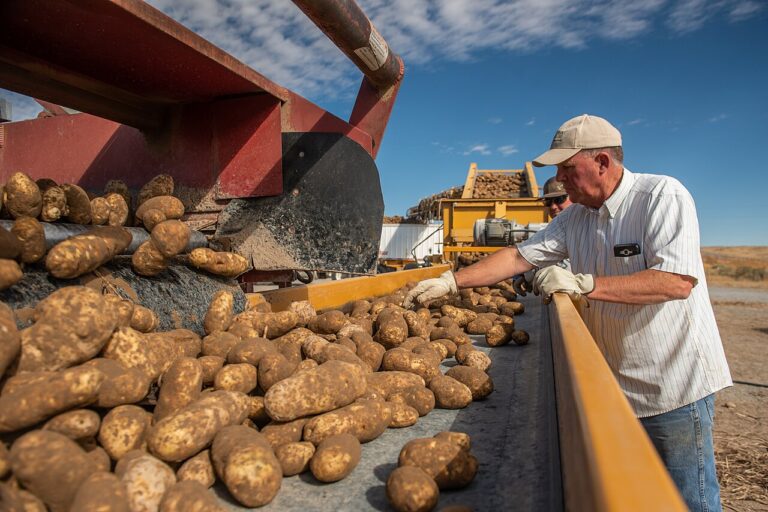
With fifteen minutes to spare before a hard deadline, most of the potato growers supplying Simplot’s processing plant in Tasmania have signed contracts for the coming season. According to the state farmers’ organisation TasFarmers, the deal leaves them with an average price cut of 2.5% — the second consecutive season in which the processor has lowered its base price while growers’ costs continue to climb.
Sign, or stop growing
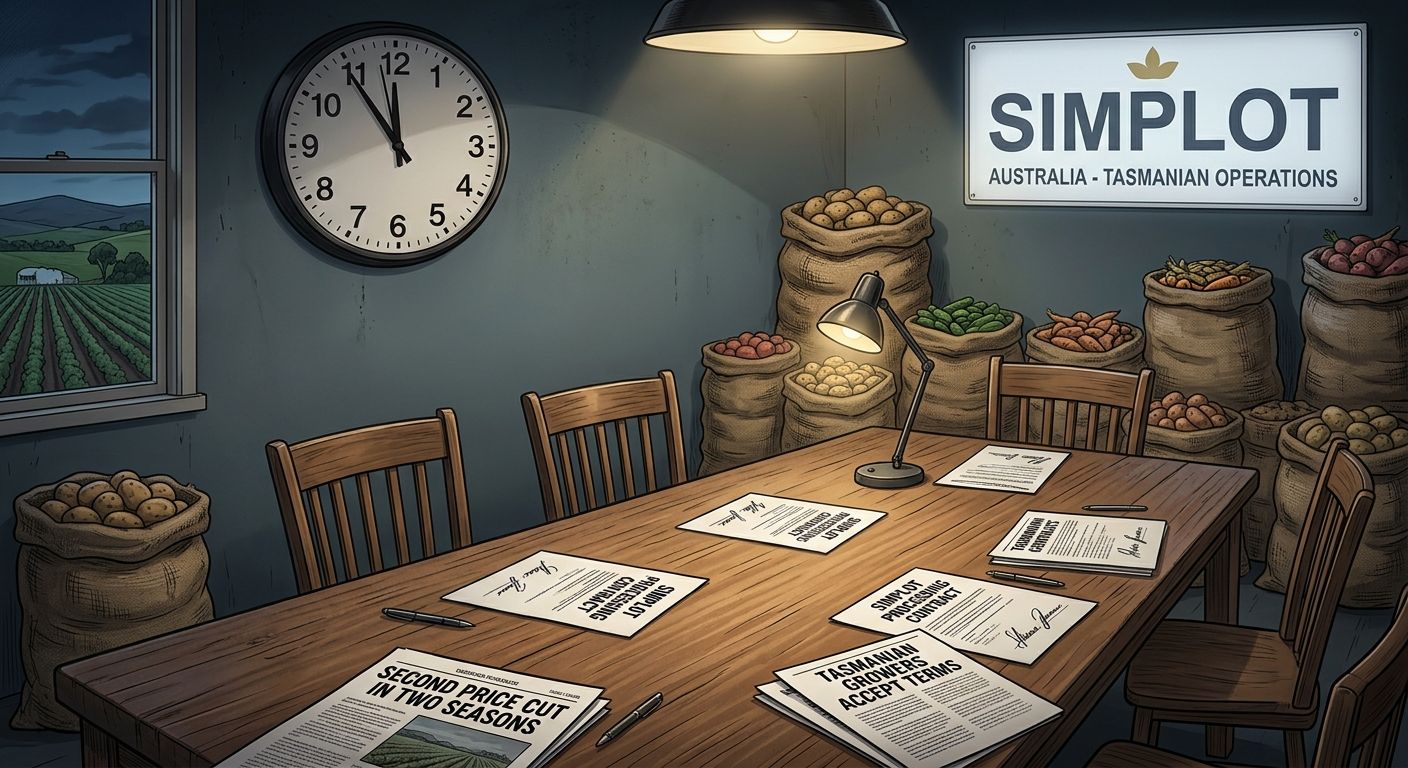
TasFarmers Chief Operating Officer Neil Grose told Tasmanian Country that Simplot set a deadline of 17:00 on 15 September. The company made clear that any grower who had not signed by then would be treated as having chosen not to grow potatoes, and that their contracted volume would be reallocated. Grose said he understood that most growers signed at 16:45.
Weekdays. Unsubscribe in one click.
At least one did not. Grose described the holdout as a fairly large grower who will simply not plant potatoes this season; TasFarmers has not named the farm.
Grose called the outcome extremely hard on Tasmania’s family farms: a 2.5% cut was painful enough, he said, but losing the contract altogether would have been devastating. He accused Simplot of caring only about its own bottom line and of cutting the price paid to the very sector its profits depend on, adding that the finished product had nonetheless become more expensive in supermarkets and fast-food outlets. That last claim comes from the growers’ side; no retail price data was cited.
Tasmania’s potato growers have a collective investment in the state of more than AUD 1.8 billion (around USD 1.3 billion) in land, machinery and other cropping assets.
How the dispute unfolded
The signing ends a bitter negotiation that ran through the Australian winter. In mid-August, as reported by ABC News and Tasmanian Country, growers rejected Simplot’s second price offer. Their objections went well beyond price:
- Simplot bypassed the grower committee that has traditionally negotiated on behalf of around 150 farms, approaching growers individually with incomplete contracts and giving them seven days to sign — before they had seen the new supply agreement.
- According to TasFarmers, the draft agreement would have made growers liable for product recalls, and any resulting legal costs, months after the potatoes had left the farm.
- Tasmanian Country also reported a proposed 1 kg cap on tuber size and a shift of insurance liability for delivery and storage onto growers.
- The Australian Manufacturing Workers’ Union said Simplot had signalled a cut of roughly 30,000 tonnes in the volume processed at its Ulverstone plant from the 2027 harvest.
The grower committee reportedly engaged lawyers and made enquiries with the Australian Competition and Consumer Commission (ACCC), the national competition regulator.
Margins measured in cents
Growers put the cost of producing processing potatoes in Tasmania — the state’s most valuable but also its most expensive crop — at around AUD 25,000 per hectare, or about AUD 0.42 (USD 0.30) per kilo. Simplot’s offer for the season was AUD 0.46–0.49 (USD 0.33–0.35) per kilo.
On those figures, our calculation puts the margin at 4–7 cents per kilo, or roughly 10–17% over cost. The growers’ numbers imply a yield of around 60 t/ha, which translates into a margin of about AUD 2,400–4,200 per hectare. A modest yield shortfall or a further rise in input costs would erase much of that. The cost estimates come from growers and have not been independently verified.
A pattern, not a one-off
Last year followed a similar script. In 2025 Simplot proposed a 6% price cut, which growers calculated would have reduced their profits by almost 40%. After a tractor convoy protest and direct talks with Simplot’s US management in Boise, Idaho, the two sides settled in October 2025 on a lower base price, with productivity incentives allowing growers to claw back the difference.
Simplot justified its pricing at the time by pointing to import competition, saying its previous cost model belonged to an era when imported potato products were less prevalent. Industry reports indicate that Australia’s imports of frozen potato products from India and China have roughly quadrupled over seven years to about 100,000 tonnes, with major supermarket chains increasingly sourcing fries from overseas processors.
Europe offers only a partial contrast
At first sight, north-west Europe is heading the other way. After the record 2025 crop, growers cut their planted area, and a summer of heatwaves and drought has hit yields. World Potato Markets estimates that the EU’s processing potato harvest could fall below 40 million tonnes in 2026 for the first time. The market has already responded: the Expana benchmark price for Belgian Fontane (EXW) rose from EUR 10/t at the end of July to EUR 150/t in early August.
That rally, however, is confined to the free-buy market. Contract prices for the 2026 crop were cut by around 20%, having been set during the glut. European contract growers are therefore also earning less this season; it is those with uncontracted volumes who stand to benefit from the shortage.
The real difference lies in market structure. Tasmania effectively has no free-buy market to fall back on. Two major processors, Simplot and McCain, dominate the state’s industry, and local politicians have warned that the loss of either would leave growers facing what amounts to a single buyer.
Why it matters
Tasmania is the grower–processor model in its purest form: one realistic buyer per contract, no alternative outlet, and pricing power concentrated almost entirely at the factory gate. The processor, in turn, is squeezed by cheap imports of finished product and passes that pressure back down to the field. The planned reduction at Ulverstone from 2027 suggests the next adjustment may not be a lower price, but a smaller raw-material base.
Source: ABC News; Tasmanian Country