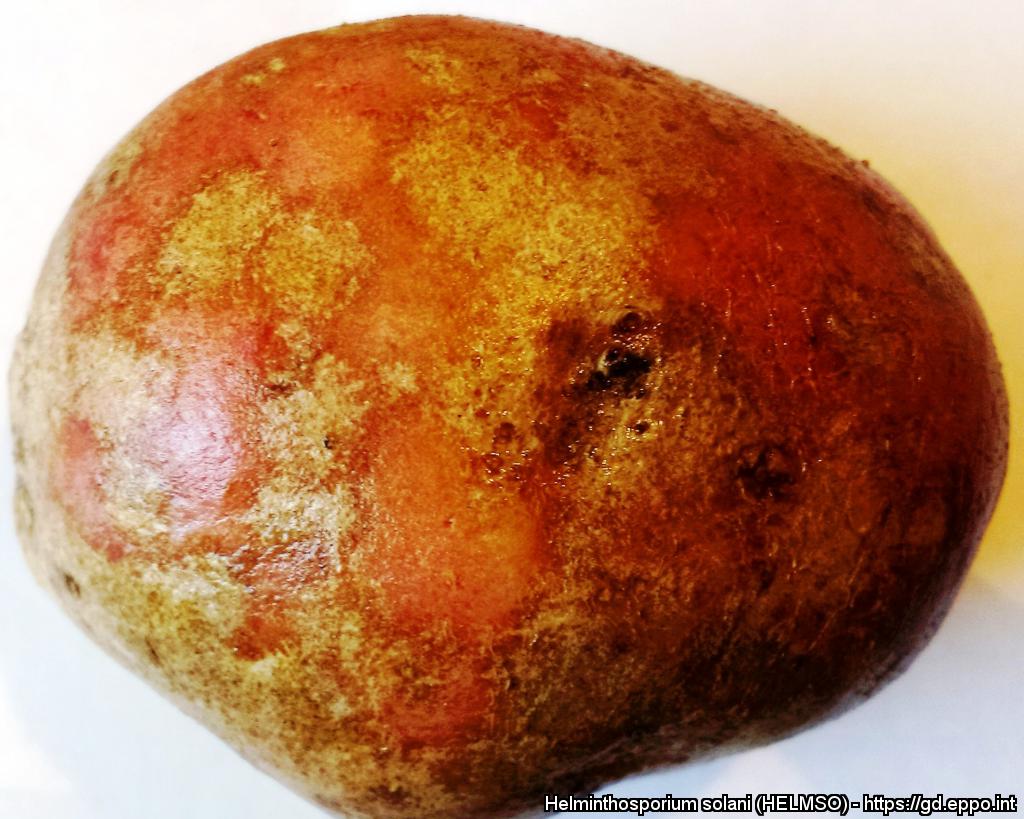
Silver scurf, caused by the fungus Helminthosporium solani, is primarily a blemish disease of potato (Solanum tuberosum) that has become economically important in recent years.
Disease symptoms appear on tubers, but not on the haulm or roots, and are limited to the periderm, composed of phellem, phelloderm and cortical layers that replace the epidermis of the tuber. The first symptoms of silver scurf on progeny tubers are light brown circular spots or lesions at the stolon end, which may become a dark olive colour as sporulation of the fungus progresses. Once established, lesions remain small on tubers in soil, but enlarge during storage. Individual lesions have definite margins, and lesions merge as the disease progresses. The silver discoloration of the periderm is caused by loss of pigment, through cell desiccation, and suberin deposition. Pigmentation of tubers is completely obscured in red cultivars. Mature lesions lose their capacity for sporulation.
Silver scurf and black dot, caused by Colletotrichum coccodes, are frequently confused. Both diseases cause blemishes on the periderm and often occur together.
H. solani is seedborne and infected seed tubers are probably the main source of inoculum for infection of daughter tubers. The pathogen produces conidia, on the surface of the seed tuber. These conidia are washed off the seed tuber and through the soil by rain or irrigation; some of these are deposited near or on the surfaces of the daughter tubers. Conidia germinate in response to free moisture and infect tubers directly through the periderm or through lenticels. The pathogen then colonizes the periderm cells. Infection can occur as soon as tubers are formed and may continue throughout the growing season. H. solani does not infect or grow along roots, stems, or stolons.
Control practices recommended for silver scurf include:
Plant certified seed.
Inspect seed when received.
Apply fungicides.
Rotate land out of potatoes for at least 2 years.
Photo: Maria A. Kuznetsova (All-Russian Phytopathology Research Institute, https://gd.eppo.int/taxon/HELMSO/photos)
References: Errampalli, D., Saunders, J.M. and Holley, J.D. (2001), Emergence of silver scurf (Helminthosporium solani) as an economically important disease of potato. Plant Pathology, 50: 141-153. https://doi.org/10.1046/j.1365-3059.2001.00555.x