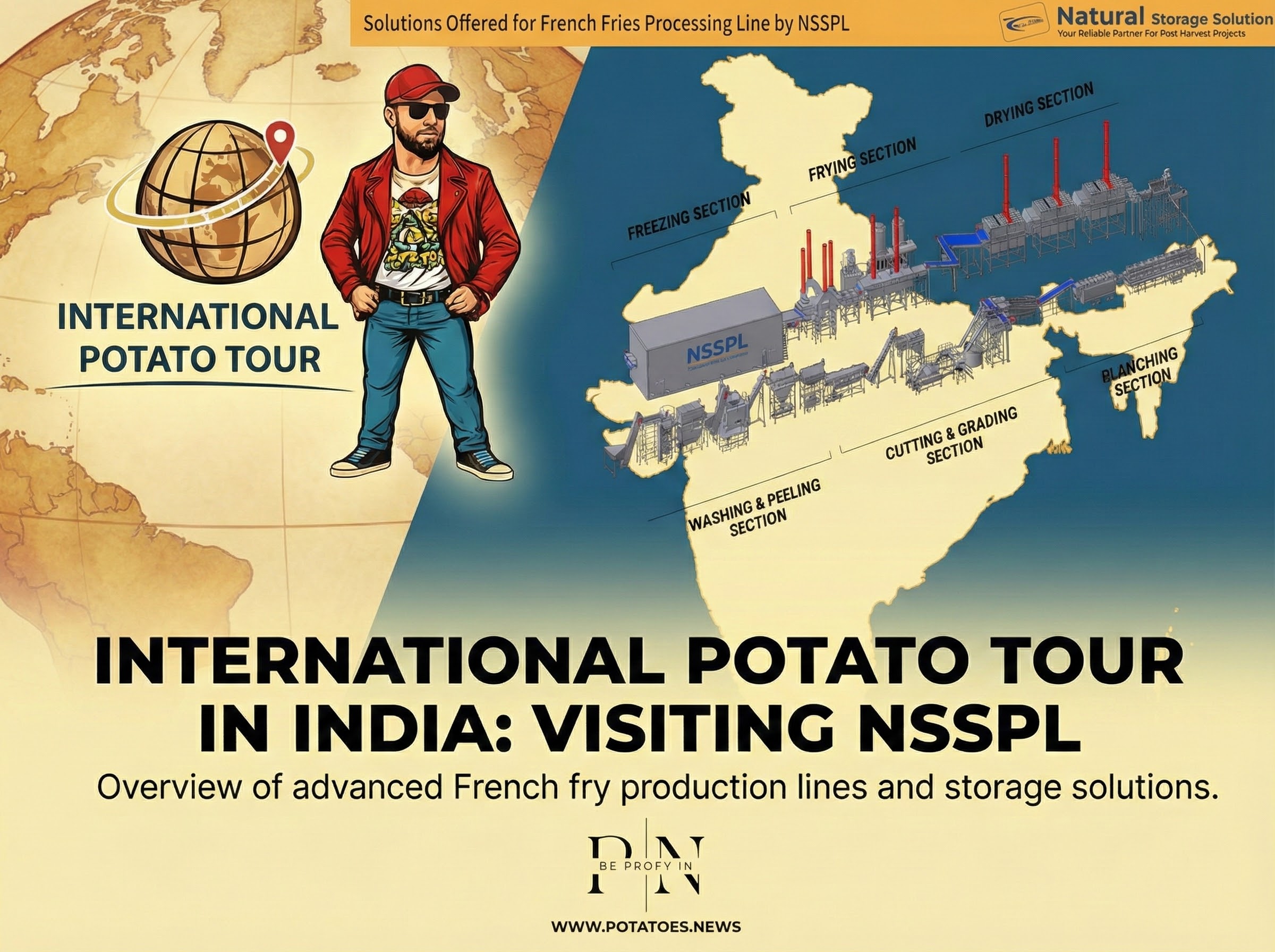
Potatoes.News report as part of the International Potato Tour — India.
During the International Potato Tour in India, we visited the production site of Natural Storage Solutions Pvt. Ltd. (NSSPL) and recorded an interview with Yogesh Dahiya, Managing Director of the company — a provider of turnkey solutions for food processing projects and cold chain infrastructure.
This was not a “showcase-only” visit. We walked through workshops and fabrication areas, discussed why NSSPL chooses specific materials for food-grade equipment, compared mechanical drive solutions versus hydraulics in certain units, and looked at energy-recovery systems used for ventilation and CO₂ management in storage facilities. We also talked about NSSPL’s expansion plans and export ambitions.
From Refrigeration to Turnkey Food Processing
Yogesh Dahiya explained that NSSPL started its journey in 1999, initially focusing on refrigeration systems. Working with cold technology naturally led the company into food processing industries, where refrigeration is only one part of a bigger production chain.
Over time, NSSPL observed a common challenge: many processors import machinery but later face issues related to installation and after-sales service. This became a key driver for NSSPL to broaden its scope and provide integrated solutions — from cold storage to processing lines and automation.
Today, NSSPL positions itself as a turnkey partner for:
- large potato storage and cold chain projects,
- food processing equipment for French fries, potato chips, potato flakes, frozen vegetables, and IQF solutions.
The company’s mission is clear: deliver international-quality machinery at a competitive price, on time.
New Facilities and a Strong Focus on Global Markets
A major highlight of the conversation was NSSPL’s expansion strategy. Yogesh Dahiya confirmed that the company is scaling up production in response to global demand, investing in new facilities equipped with advanced CNC machinery to manufacture high-precision components for processing projects.
NSSPL now has a team of 600+ people, and its strategic goal is to establish itself as a global player capable of delivering complex processing and cold storage solutions quickly, reliably, and at high quality.
Two Materials, Two Production Logics: MS vs SS
One of the most practical parts of the tour was the material and fabrication discussion.
The site is structured around two units:
- Unit 1 — MS fabrication (mild steel / “black steel”)
- Unit 2 — SS fabrication (stainless steel)
The logic is straightforward:
- equipment and components in direct food contact are produced from stainless steel (SS),
- many supporting structures, certain refrigeration-related assemblies, bunkers, and heavy-duty parts are often manufactured using mild steel (MS).
We saw laser cutting machines that, according to NSSPL representatives, can cut:
- MS material up to 25 mm,
- and on another unit, “black steel” up to 40 mm, with high precision.
Surface Treatment: Not Just Painting
NSSPL also highlighted the importance of surface preparation and finishing quality.
For mild steel vessels, the company uses shot blasting rather than simple painting — to improve paint adhesion and durability.
For stainless steel and food-grade components, NSSPL uses glass beading, which:
- removes impurities and visual marks after fabrication,
- improves appearance,
- helps avoid visible dark spots in welded areas.
Cold Storage Engineering: Compressors, High Capacity, and Exports
The discussion also covered refrigeration engineering. For larger projects, NSSPL uses screw compressors, which are needed when required capacity becomes too high for standard reciprocating compressor setups.
Export shipments were mentioned as well — including equipment and control panels prepared for projects in Saudi Arabia.
Engineering Choices: Hydraulics vs Gear Motor — and Cleaning During Harvest Season
A lively section of the tour focused on a real-world engineering dilemma:
hydraulic systems vs gear motor drives for rollers/shafts and moving elements in grading and handling equipment.
NSSPL explained that in certain designs they use a gear motor to maintain and control the gap between rollers more precisely, without necessarily requiring hydraulics.
From the tour team’s side, practical questions came up: how systems behave during harvest when potatoes carry heavy soil load, how quickly the machine can “shake off” dirt, and whether a high-speed cleaning mode (seen in some European designs) is possible or preferable. The discussion stayed technical and honest — focused on real operating conditions, not marketing.
Energy Efficiency: Energy Recovery Wheel and CO₂-Related Ventilation
Another notable element was an energy recovery wheel system. The idea is energy savings when storage chambers need to remove CO₂-rich air and bring in fresh outside air, which is often warmer.
The wheel transfers temperature between air streams:
- cold air cools the wheel,
- then incoming warm air passes through and becomes cooler, reducing energy loss.
NSSPL described this as part of an energy recovery system, with a broader approach including CO₂ extraction/management solutions.
NSSPL’s Strength: In-House Manufacturing and Customization
One message was repeated several times during the factory walk-through: in-house production + customization.
NSSPL believes standard off-the-shelf equipment often creates inefficiencies — wasted space, wrong flow design, unnecessary capacity, or poor fit in a facility layout. By manufacturing internally, the company can:
- tailor equipment to specific requirements,
- optimize height, layout, and capacity,
- assemble electrical panels and enclosures in-house,
- run testing, programming, and keep engineering drawings for future service support.
Market Outlook: GCC, Africa, Russia, Iran — and Medium-to-Large Projects
Yogesh Dahiya openly discussed target markets beyond Asia, noting strong potential in:
GCC countries, Africa, Russia, Iran, and other regions where cold chain and processing capacities are expanding.
He also emphasized NSSPL’s intent to serve both:
- medium-scale projects, and
- large-scale industrial solutions,
covering a broad range of customer needs.
Closing Words
In the final remarks, Yogesh Dahiya thanked the International Potato Tour for creating a platform that connects people in the industry — helping newcomers understand the sector and enabling solution providers to explore new markets and partnerships.