For over a century, potato breeding has been constrained by the crop’s biological blueprint: complex tetraploid genetics and the cumbersome logistics of vegetative seed tubers. Today, a paradigm shift is underway. Building on a foundational 1999 discovery by Japanese scientist Kazuyoshi Hosaka of the Sli gene—which enables self-pollination in potato—breeders have cracked the code for diploid hybrid breeding. As Royal HZPC Group prepares to launch its NOVA hybrid potato lines, the agricultural community is witnessing the arrival of a tool that promises to redefine variety development and seed delivery, particularly for the Global South.
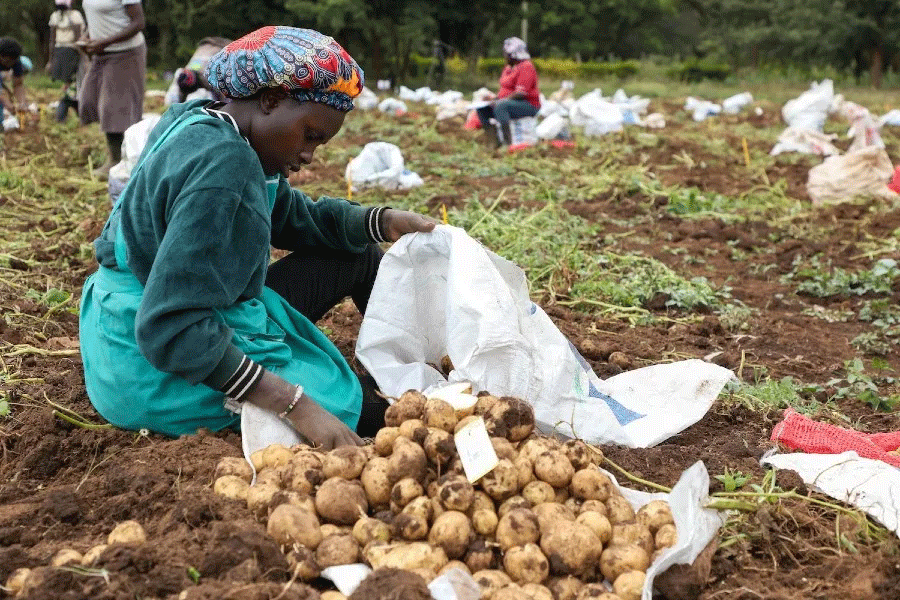
The immediate impact is most profound where conventional seed systems fail. In Kenya, a focal point for HZPC’s rollout, only 10% of the nation’s 800,000 small-scale potato farmers have reliable access to certified, disease-free seed tubers. This gap directly undermines food security and income. Hybrid True Potato Seed (TPS) presents a disruptive solution: it is pathogen-free at source, exponentially easier to store and transport (1 kg of TPS equals ~2,000 kg of seed tubers in planting potential), and can be produced centrally for widespread distribution. HZPC’s lead candidate for Kenya, D23HY2515, demonstrates the agronomic promise, matching the yield of the dominant local variety ‘Shangi’ while exhibiting dual resistance to late blight—a disease causing over $10 billion in global annual losses. In Kenyan trials without crop protection, this inherent resistance is critical, as many farmers cannot afford or access fungicides.
However, the path from a tiny seed to a table-ready tuber involves nuance. As HZPC’s experts clarify, the initial “seed-to-seed” cycle from TPS is longer, taking 100-120 days to produce a crop of small “seed tubers.” These tubers are then planted in a second, standard growing season to produce a commercial ware crop. Therefore, the hybrid model doesn’t eliminate tubers but revolutionizes the starting point of the seed multiplication chain, making it more efficient and genetically robust. This two-generation system allows for rapid, centralized production of clean, high-quality seed tubers that can then be distributed locally. While Europe’s established, high-throughput tuber-based seed industry means hybrid adoption there will be gradual, the potential for faster breeding cycles is universal. Recent analyses suggest hybrid breeding can shorten the variety development timeline from 12-15 years to 5-7 years, allowing a quicker response to emerging threats like new pathogen strains or drought.
The advent of commercially viable hybrid potatoes marks a watershed moment not just in plant breeding, but in the practical pursuit of agricultural resilience. Its greatest triumph is decoupling genetic innovation from the phytosanitary and logistical bottlenecks of traditional seed tuber systems. For scientists, it offers a more precise and rapid breeding platform. For agronomists and farmers in Africa and Asia, it represents a tangible path to accessing affordable, climate-resilient, and high-performing planting material. While the technology will integrate with, not replace, established tuber practices in the near term, it fundamentally changes the economics and equity of seed access. The future of potato cultivation, especially for vulnerable smallholder communities, is increasingly being written not in the field, but in the genetics of a true seed.