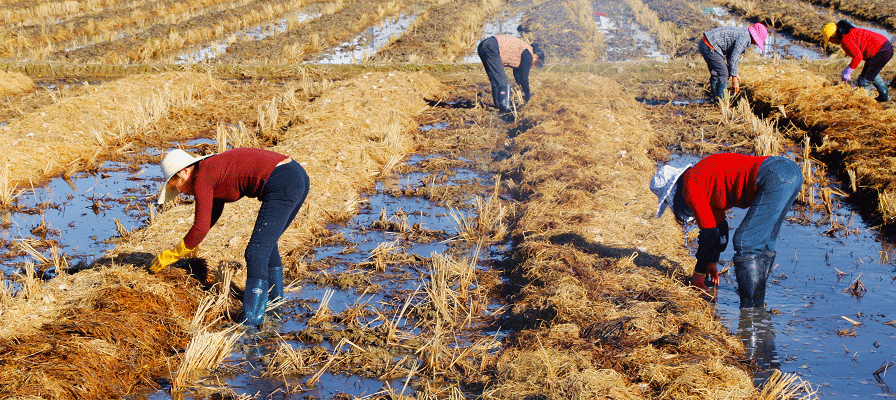
In Sha Tou Town, Ziyang District, the traditional practice of burning rice straw has been replaced by a sophisticated, dual-pathway system that transforms this agricultural residue into a cornerstone of farm profitability and soil health. The “green revolution” centers on two primary applications: using shredded straw as a “golden blanket” mulch for winter potato crops and as a fermented substrate for cultivating Stropharia rugosoannulata, or king stropharia mushrooms. This approach directly tackles a major global agronomic challenge. According to the FAO, open burning of crop residues is a significant source of air pollution and greenhouse gases, while removing these residues disrupts nutrient cycles. The Sha Tou model offers a compelling alternative by retaining organic matter within the local farming system.
The potato operation spans over 180 mu (approximately 30 acres) using a “lazy potato” method, where straw mulch suppresses weeds, conserves soil moisture, regulates temperature, and—as it decomposes—adds organic matter and nutrients back into the soil. Following the potato harvest, the partially decomposed residue is tilled in, becoming a “nutrient meal” for the subsequent rice crop, creating an efficient annual rotation. Concurrently, a separate operation utilizes straw as a primary component in substrate for king stropharia mushrooms. Grown on 80 mu (about 13 acres), this high-value fungus achieves yields exceeding 1,000 kg per mu, generating an estimated revenue of 20,000 RMB per mu (roughly $28,000 per acre). Post-harvest, the spent mushroom substrate is repurposed as a high-quality organic fertilizer, completing a true circular loop. Collectively, these two enterprises utilize straw from 8,000 mu of rice fields, processing an estimated 2,500 tons of material that would have otherwise been burned.
The Sha Tou Town case study is a powerful testament to the economic and environmental logic of circular agriculture. It moves beyond seeing crop residue as a waste disposal problem, instead viewing it as a versatile raw material for value creation. For farmers and agronomists, it demonstrates that integrating residue management into crop planning can reduce input costs (herbicides, irrigation, fertilizer), improve soil structure, and open new revenue streams through high-value niche crops like gourmet mushrooms. For agricultural engineers and scientists, it highlights the need for practical, scalable technologies for residue collection, processing, and composting. This model provides a replicable blueprint for regions worldwide grappling with residue management, proving that “waste” can indeed be woven into the fabric of a more resilient and profitable farming system.