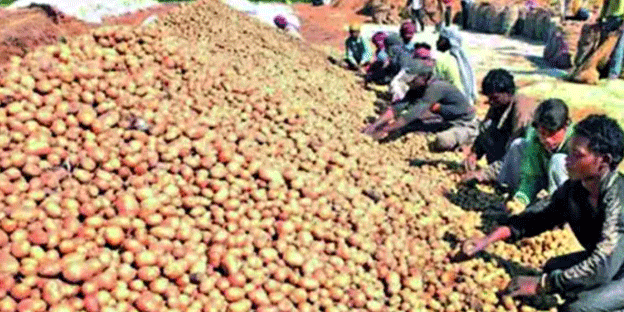
Each year, as potato harvests peak in Cooch Behar district, farmers celebrate robust yields—but also face a familiar problem: insufficient cold storage space. With production levels routinely outpacing local capacity, logistical bottlenecks threaten to compromise the quality and marketability of the harvest.
To address this, Alipurduar district, known more for its tea gardens and forested landscapes than its farmland, is once again stepping in as a critical storage partner. In a tripartite meeting held at Dooars Kanya, administrative officials and cold storage owners from both districts formalized an agreement to store approximately 30–35% of Cooch Behar’s surplus potatoes in Alipurduar’s 14 operational cold storage facilities.
Why This Matters: Regional Cooperation in Action
Snigdha Shoiba, Sabhadhipati of Alipurduar Zilla Parishad, explained the rationale:
“Since agricultural activity in Alipurduar is relatively limited, our cold storage units typically operate below full capacity. It’s practical and mutually beneficial to allocate space for our neighboring district’s surplus potatoes. This cooperation has become a regular, structured part of our regional agricultural planning.”
This kind of inter-district collaboration is essential in maintaining the integrity of the potato value chain. Without timely storage, harvested potatoes are vulnerable to spoilage, sprouting, and quality degradation—leading to both economic losses for farmers and supply fluctuations in local markets.
Understanding the Storage Gap
West Bengal is one of India’s largest potato-producing states, with an annual output of around 14 million tonnes. Cooch Behar alone contributes significantly to this total due to its favorable agro-climatic conditions and widespread cultivation of high-yielding varieties such as Jyoti and Pokhraj.
However, according to the West Bengal Cold Storage Association, the state’s overall cold storage capacity (around 7 million tonnes) still struggles to match seasonal production peaks. The imbalance is especially pronounced in high-yielding districts like Cooch Behar, where local infrastructure hasn’t kept pace with expanding cultivation.
Alipurduar, on the other hand, with its limited potato cultivation and underused facilities, provides an ideal buffer zone. By absorbing the surplus, it not only supports farmers but also maximizes infrastructure utility across district lines.
Operational and Economic Implications
For farmers, this arrangement:
- Reduces post-harvest losses
- Delays distress sales, allowing them to wait for better prices
- Strengthens regional marketing systems, creating price stability
For cold storage operators, especially in Alipurduar:
- Increases occupancy rates
- Enhances profitability
- Strengthens their role in the agricultural supply chain
For local authorities, this model reinforces the value of policy-driven coordination, showing that cross-district agricultural planning can offer real solutions to infrastructural limitations.
A Scalable Model for Other Regions
The Alipurduar-Cooch Behar arrangement serves as a practical example of how inter-district collaboration can mitigate structural limitations in agriculture. As climate variability and production intensity continue to challenge traditional supply chains, adaptive storage logistics like this may become increasingly necessary across India’s food-producing regions.
Policymakers elsewhere would do well to study this model—not only to solve capacity issues but also to optimize regional agricultural infrastructure and ensure farm-level profitability.