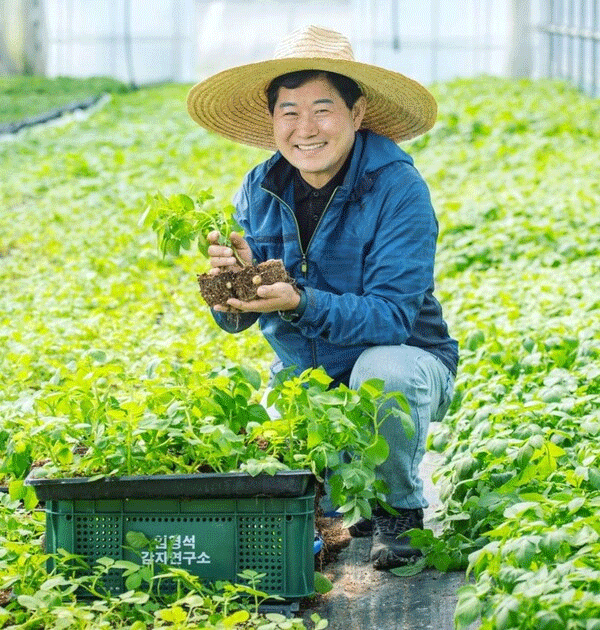
In Sri Lanka’s central highlands, the climate crisis is not a future projection but a present-day agricultural collapse. Recent catastrophic floods in key potato-growing regions like Badulla and Nuwara Eliya have left farmers destitute. The traditional, decades-old variety ‘Granola’ recorded a near-total failure yield of just 2.49 tonnes per hectare in official trials, a stark indicator of systemic vulnerability. This mirrors a breakdown South Korea itself experienced a decade ago, where established varieties like Sumi and Atlantic succumbed to new patterns of drought, heat, and disease. Professor Young-Seok Lim of Kangwon National University, a globally recognized potato breeder, frames this succinctly: “Climate change has now moved beyond an agricultural threat to a survival crisis.”
In response, a collaborative project led by Professor Lim and supported by KOICA is piloting a powerful solution: the introduction of “K-Potato” varieties. In official two-season trials, four out of five introduced Korean varieties—including Golden King and Happy King—dramatically outperformed local standards. The results were staggering: during intense rainy seasons, Golden King’s yield increased nearly tenfold compared to collapsing local varieties, demonstrating exceptional tolerance to excessive moisture. In drier periods, the Korean lines maintained superior stability. This success led to an expanded strategy; Professor Lim introduced three more varieties (Great King, Smile King, Kangdae King) to create an eight-variety portfolio tailored to diverse and unpredictable conditions. This multi-variety strategy is critical, as Professor Lim notes, “Sri Lanka is an environment where a single variety cannot survive.”
However, the project’s most transformative element is not the seed itself, but the transfer of 91 distinct breeding lines to Sri Lankan research institutions. This marks the launch of Sri Lanka’s first-ever indigenous potato breeding program. Moving beyond aid dependency, this empowers local scientists to develop their own climate-resilient varieties. This model aligns with a growing global recognition that climate adaptation requires localized genetic solutions. The K-Potato initiative, now active in over 40 countries from Algeria to Uganda, exemplifies a new paradigm of agricultural development cooperation focused on building long-term, in-country breeding capacity.
The K-Potato project in Sri Lanka is a seminal case study in climate-resilient agriculture. It demonstrates that the immediate solution to climate-induced crop failure lies in deploying a diverse portfolio of pre-bred, stress-tolerant varieties that can provide a yield buffer and food security. More importantly, it proves that sustainable resilience is built by equipping nations with the genetic tools and scientific autonomy to run their own breeding programs. For farmers and agronomists worldwide, this underscores that adapting to climate volatility will depend less on a single miracle crop and more on robust, decentralized breeding ecosystems capable of continuous local adaptation. The future of food security hinges on empowering every region to write its own genetic future.