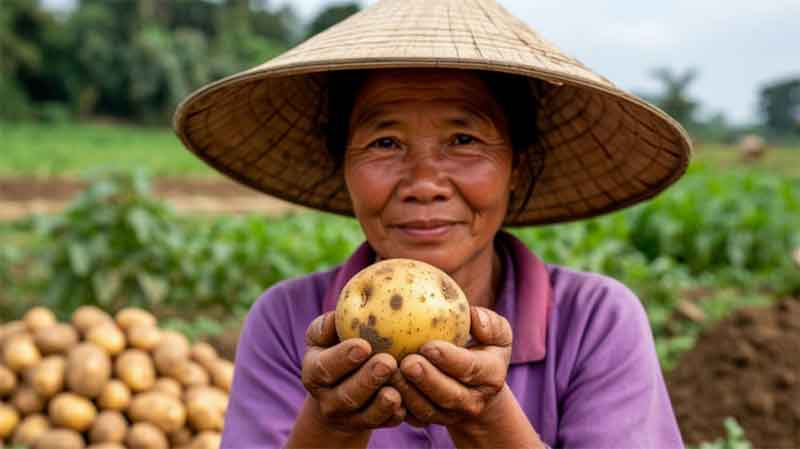
The production linkage model implemented in Khanh Yen commune represents a deliberate institutional departure from the fragmented, trader‑dependent cultivation that previously defined winter potato farming in the region [source text]. Historically, growers operated on dispersed micro‑plots, relied on retained seed of uncertain health, and sold into opaque spot markets—a configuration that suppressed both yield and price. The 2025–2026 intervention restructured every node of this chain. Participating households received certified seed and agro‑inputs directly from the partnering enterprise; technical extension staff provided plot‑level guidance on planting geometry, irrigation scheduling, and integrated pest management; and a binding procurement contract fixed the purchase price at 15,000–20,000 VND/kg, delinking grower income from post‑harvest trader negotiations [source text]. The outcome—20–30 t/ha on first‑adoption fields—was not exceptional by international processing standards, but it was transformative in a local context where baseline productivity had been constrained by inconsistent seed quality and absent quality‑based pricing [source text].
Khanh Yen is not an isolated pilot; it is part of a discernible regional shift toward processor‑driven supply chains. In Tuyen Quang province, PepsiCo and Viettrans have implemented the FL2215 processing potato model on 17 ha, achieving average yields of 28 t/ha and net returns of 50–60 million VND/ha at a contracted price of 7,500 VND/kg—despite this being only the second year of local adoption . In Bac Giang and surrounding provinces, Orion Vina Food Co., Ltd. contracts winter‑spring potato production at guaranteed prices (8,500 VND/kg in recent seasons), with company agronomists providing regular field guidance and farmers reporting yields of 36–37 t/ha—approximately 30% higher than conventional methods—and net returns approaching 150 million VND/ha . These parallel cases share a common architecture: private‑sector provision of technical services, formal price commitments, and varietal specifications aligned with downstream processing requirements. Critically, Orion Vina’s domestic procurement still meets only a fraction of its 60,000 t annual processing demand, confirming that the constraint is not buyer willingness but insufficient scaled supply of quality‑assured raw material .
The role of public agricultural extension in enabling such transitions has received explicit policy reinforcement. General Secretary To Lam’s Conclusion Notice No. 371‑TB/VPTW (October 2025) directs that agricultural extension must be treated as a core function of commune‑level governance, not “contracted out” or deprioritized . Minister of Home Affairs Phạm Thị Thanh Trà has articulated a reconceptualized mandate: extension officers are to function as “innovation architects,” facilitating two‑way knowledge exchange rather than delivering top‑down prescriptions . The Khanh Yen model exemplifies this principle—technical staff worked directly in fields, and farmer testimony repeatedly attributes confidence and yield gains to this plot‑level presence [source text]. This stands in contrast to earlier contract farming experiments documented in central Vietnam, where cooperative‑mediated linkages improved productivity and market access but failed to induce structural labor reallocation, leaving participating households as smallholders reliant on family labor . The difference in Khanh Yen may lie in the intentional bundling of technology transfer, input provision, and output price certainty within a single, visibly functional system.
The commune’s decision to expand to 50 ha for the 2026–2027 winter crop is therefore not speculative; it is a calculated scale‑up of a validated operational template [source text]. From an agronomic engineering perspective, the key variables are now known: suitable winter niche identification (post‑rice paddy, cool temperatures, residual moisture), seed supply chain integration, and varietal selection matching buyer specifications. The price achieved—15,000–20,000 VND/kg—exceeds the January 2026 Hanoi wholesale reference of 30,000 VND/kg only when adjusted for retail margin, but it represents a substantial premium over uncommitted spot sales and is consistent with contemporary contracted prices documented in other northern provinces .
The Khanh Yen winter potato model demonstrates that the primary barrier to commercial transition in smallholder systems is not farm size, climate, or grower capability—it is the absence of a coordinated institutional vehicle that simultaneously delivers seed quality, production knowledge, and price assurance. The commune achieved in one season what years of untargeted extension and sporadic trader procurement could not: measurable yield gain, documented farmer satisfaction, and a committed expansion trajectory. For agricultural professionals operating in analogous environments, the implication is unambiguous. Further pilots are not required. The intervention logic is proven, the unit economics are positive, and the replication pathway—partnership with committed buyers, integration of technical extension into contract design, and transition from fragmented planting to concentrated, block‑scale cultivation—is transferable. The question now is whether provincial and national programs will systematically adopt this template, or whether Khanh Yen will remain a localized success awaiting institutional capture.