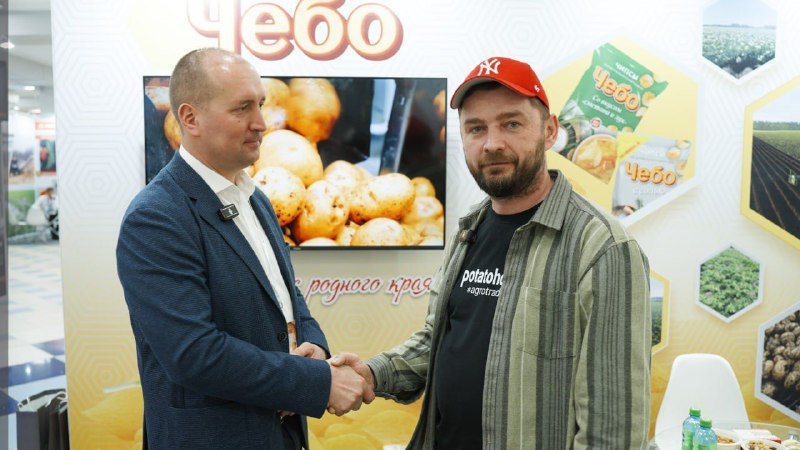
As part of the International Potato Tour, we continue to meet unique producers who prove that success in the agricultural market depends not only on sown areas but also on ingenuity. Our stop today is the Chuvash Republic, where a small farm established the potato chip brand “Chebo,” combining advanced agricultural technologies with national culinary traditions.
Kuznetsov Valery Leonidovich, the head of the farm, told us about how to turn forced crop rotation into a successful niche business, why small farmers shouldn’t compete with agricultural holdings, and what Chuvash shyrtan tastes like in snack format.
From Onions to Potatoes, from the Field to Processing
The history of the “Chebo” brand began not with ambitious plans to conquer the snack market, but out of strict agricultural necessity. Historically, the farm specialized in growing onions. As the enterprise developed, circular irrigation machines were installed in the fields, which required strict crop rotation.
“We can only plant onions on the same field once every five years. And the irrigation system shouldn’t stand idle for those four years,” Valery Leonidovich explains. “Sowing grain on small irrigated areas is not interesting. That’s how we got the idea of vegetables: cabbage, beetroot, and potatoes.”
However, growing table potatoes harbored serious economic risks. Neighboring regions and large farms produce potatoes by the thousands of tons. It would be ruinous for a small farm to compete with them on price—as the manager metaphorically put it: “they would simply bury us.”
Having considered options for processing into starch (too cheap a raw material) and French fries (requires a large-scale and expensive plant), the farmers found the perfect balance: their own small shop for producing potato chips.
First Steps: Business as a Child
The chip market is densely occupied by large international and federal players, so starting their own production was not easy.
“Fear has big eyes,” the farmer smiles. “But we moved step by step, mastering the technologies. It’s like a baby being born: first it crawls, then it stands up, falls, gets a bump, gets up again, and walks further.”
Today, the company’s production division is only two years old. By business standards, this is the age of a toddler who is just learning to walk confidently and say its first words. Nevertheless, the “child” is developing rapidly: the company is already planning a rebranding, expanding production, and actively collaborating with large partners, producing chips for their needs as well.
A Flavor Like No Other: Shyrtan and Kazy
The special pride of the “Chebo” brand is its flavor line. Currently, 13 types of chips are produced. Naturally, the assortment includes recognized bestsellers: crab, sour cream and onion, cheese, greens. However, the farmers decided to go further and reflect the multinational character of their region in the product.
In the district where the production is located, different peoples have historically lived in peace and harmony: about 70% are Chuvash, 30% are Tatars. This harmonious neighborhood is reflected in two exclusive flavors of “Chebo” chips that have no analogues on the market:
- Shyrtan flavor. Shyrtan is a traditional Chuvash festive dish made of minced meat, baked in a natural casing in the oven. A real delicacy served to dear guests.
- Kazy flavor. Kazylyk (kazy) is a traditional dry-cured horse meat sausage in a natural casing, popular among Tatars and other Turkic peoples, an invariable attribute of a festive feast.
Now, Leonid Andreevich jokes, when visiting someone, you can safely take a pack of “Chebo” chips with a national flavor—such a gift will definitely hit the spot.
Advice to Colleagues
The story of “Chebo” is a vivid example of how small agribusiness can find high-margin niches, avoiding direct competition with industry giants. Betting on local identity, deep processing of their own raw materials, and courage in exploring new directions are bearing fruit.
When asked what he would wish other farmers, Valery Leonidovich answers simply and cheerfully: “Don’t lose heart. Everything will be fine!”
Specially for the “International Potato Tour” project.