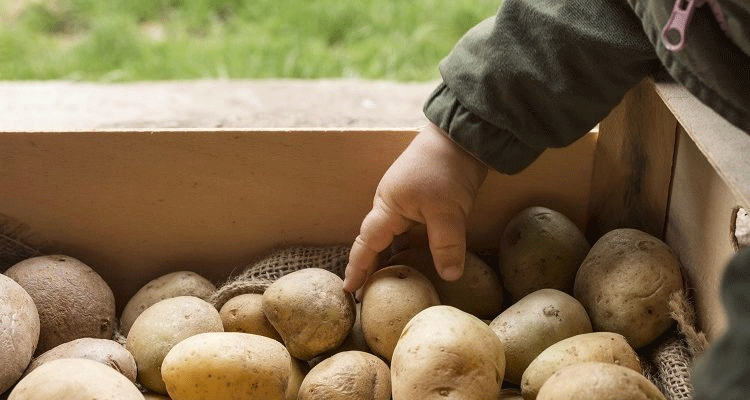
In a landmark achievement for its agricultural sector, Russia’s industrial potato producers—comprising agricultural organizations and peasant farms—have set a new national yield record in 2025. Preliminary data from Rosstat, analyzed by AB-Center, indicates a harvest of approximately 8.47 million tonnes from the industrial sector, marking a significant 16% year-on-year increase. The most striking figure, however, is the record-breaking average yield of 310.8 centners per hectare (c/ha), or roughly 31.1 tonnes per hectare. This represents a dramatic 15% jump from the 2024 average of 270.2 c/ha and solidifies a trend of intensification. Remarkably, this surge in output was achieved despite a marginal 0.5% contraction in planted area, demonstrating that gains were purely productivity-driven. The yield gap between different production models remains notable, with large agricultural organizations averaging 331.6 c/ha, while smaller farm holdings achieved 278.4 c/ha.
Regional performance was pivotal to this success. The Bryansk Oblast emerged as the standout contributor, increasing its potato harvest by an astonishing 34% to reach 1.32 million tonnes, cementing its role as a national leader in both volume and growth rate. This regional surge is not isolated but part of a broader modernization push. According to a recent USDA Foreign Agricultural Service report, Russian agriculture has seen sustained investment in high-quality seed potatoes, precision irrigation systems, and integrated nutrient management. Furthermore, the adoption of modern storage infrastructure is reducing post-harvest losses, allowing productivity gains to translate more effectively into marketable supply. This focus on technology and best practices, rather than area expansion, is a key indicator of a maturing and efficiency-focused sector.
Russia’s 2025 potato harvest is more than a statistical anomaly; it is a clear testament to the sector’s successful pivot toward intensive, knowledge-driven production. The record yield underscores the powerful impact of adopting advanced agronomic techniques, improved genetics, and smarter resource management. For the global agricultural community, this serves as a compelling case study: in an era of climate uncertainty and pressure on arable land, the most reliable path to food security and economic resilience lies in maximizing the output of every hectare. The challenge now for Russia’s potato industry will be to sustain this momentum by bridging the yield gap between large-scale and smaller farm operations, ensuring that the benefits of precision agriculture become widespread.