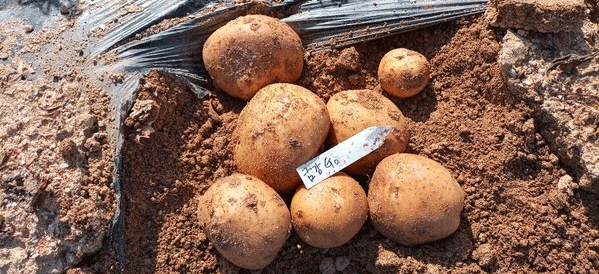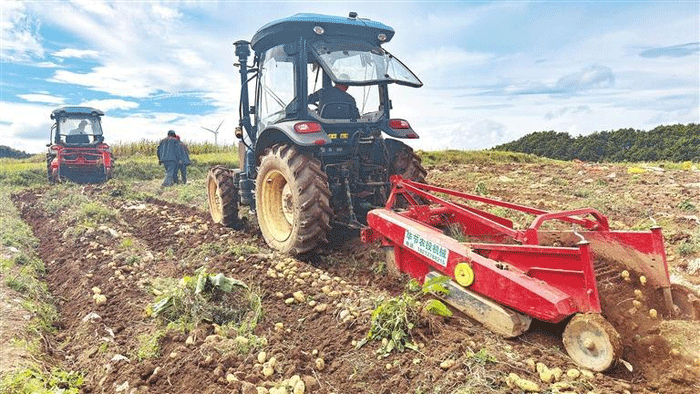
In the misty fields of Weining Autonomous County, a quiet revolution is underway. The sounds of large-scale potato harvesters at work in Guannefeng Hai town symbolize a profound shift for a region with over four centuries of potato cultivation history. As reported, a local grower demonstrated that mechanization slashed labor from 100 to 20 workdays for a 20-mu plot (approximately 1.33 hectares), a dramatic 80% reduction. This efficiency gain is part of a targeted county-wide strategy. On a 2,000-mu (about 133-hectare) demonstration base, integrated mechanization and scientific pest management have reportedly reduced production costs by 800 RMB per mu while increasing yield by over 2,000 jin (1 metric ton) per mu. This focus on precision and efficiency is critical for an industry of Weining’s scale: with a stable annual planting area of 1.5 million mu (100,000 hectares), a total output of 3 million tons, and a comprehensive industry value of 4 billion RMB, even marginal gains have massive aggregate impact.
Weining’s success is not solely due to machinery. It is a masterclass in systems-based agricultural planning, built upon three interconnected pillars. First, strategic altitudinal zoning: cultivating early-maturing varieties below 1,900 meters and mid-to-late maturing varieties above 2,200 meters optimizes growing seasons and land use. This geographical stratification mitigates climate risks and extends market availability. Second, seed system sovereignty: the county has invested in a cutting-edge seed potato propagation center with an annual capacity of 700 million plantlets and over 80 million minitubers. This domestic capacity is essential for varietal control, disease-free planting material, and reducing dependency on external seed sources, a vulnerability highlighted in recent global supply chain analyses. Third, value chain integration: a 500-mu processing park with a 1-million-ton fresh potato capacity ensures a stable market for raw produce, while the development of brands like “Southern Shubao” moves the industry beyond commoditized bulk sales toward consumer-recognized value.
This model aligns with broader trends in global agriculture, where regions are moving from simple production to managed, knowledge-intensive food systems. A 2023 FAO report on climate-smart agriculture emphasizes that integrating improved technologies (mechanization), agro-ecological practices (altitudinal zoning), and strong institutions (local R&D and processing) is key to building resilient and productive sectors. Weining’s approach directly addresses the core challenges of labor scarcity, climate adaptation, and market volatility.
Weining County presents a compelling and replicable blueprint for modernizing a traditional staple crop industry. Its transformation is multifaceted, proving that sustainable intensification requires simultaneous advances in field operations (mechanization), biological and environmental management (zoning, seed science), and economic structure (processing, branding). The reported results—dramatic labor savings, significant cost reduction, and substantial yield increases—demonstrate the tangible benefits of this integrated strategy. For agricultural professionals worldwide, Weining’s lesson is clear: long-term competitiveness in staple crops depends on moving beyond fragmented improvements to orchestrate a holistic, technology-enabled, and market-connected production system.