The German potato market is currently presenting a textbook case of agricultural economic paradox. Despite a reported 7% expansion in area and a harvest increase of over 5%, leading to one of the largest crops in recent years, producer prices have collapsed to unsustainable levels. According to the Agrarmarkt Informations-Gesellschaft (AMI), farmers are receiving an average of only €10 per 100 kg—a price that fails to cover production costs for many. This situation is exacerbated by a Europe-wide bounty; according to Eurostat, the EU-27 potato production for 2023/24 is forecast to be robust, creating a saturated continental market. This surplus leaves German producers with diminished leverage and highlights a critical vulnerability: an over-reliance on the fresh market without corresponding contract security.
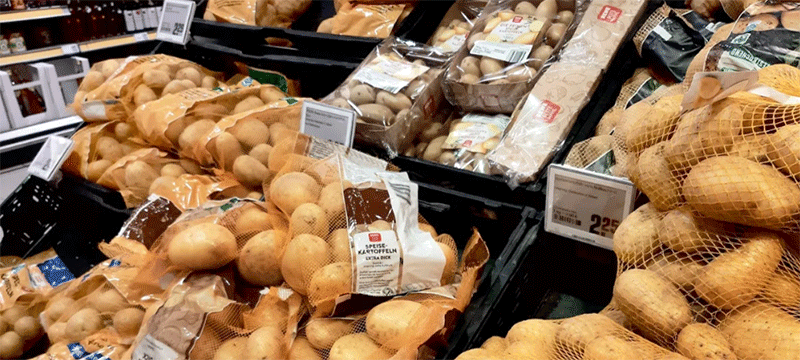
The disconnect is starkly visible in the retail sector, where consumer prices remain stubbornly high, often exceeding €1.50 per kg. This creates a margin of ten to fifteen times the farmgate price, fueling frustration among both producers and consumers. The explanation lies in the cost structures of the downstream supply chain. As noted by Sebastian Schwarz of the Union der Deutschen Kartoffelwirtschaft (Unika), packing operations, logistics, and retail all maintain their margins, insulating the consumer price from the farm-level glut. Compounding this is intense global competition in the processing sector. The rise of low-cost producers like China and India in the frozen french fry market, coupled with a strong Euro making European exports less competitive, has closed a vital outlet for surplus volumes. This global shift is reflected in trade data from the World Potato Congress, which shows a significant increase in processing capacity and export ambition in Asia, directly challenging traditional European dominance.
Furthermore, the inherent specialization of the potato industry intensifies the crisis. Potatoes are bred for specific purposes: table stock, starch, or processing. The inability to divert, for example, a surplus of starch potatoes to the fresh market means that non-contracted growers face a dire situation. With expensive and time-limited storage options, these potatoes often become a loss leader, diverted to animal feed or biogas plants, or in the worst cases, left unharvested. This represents not just an economic failure but a significant waste of resources and food.
The current German potato crisis is a powerful reminder that production volume alone is not a reliable indicator of sector health. The system is breaking at the point of market coordination and value distribution. The solution requires a multi-faceted approach: increased contract farming to de-risk production, strategic investment in processing and export infrastructure to compete globally, and greater transparency in the supply chain to ensure a fairer distribution of the final consumer euro. For farmers and agronomists, the takeaway is clear: operational excellence in the field must be matched by strategic market engagement. The future lies not just in growing more, but in growing smarter, with secured offtake agreements and a clear understanding of the volatile global forces that now dictate local profitability.