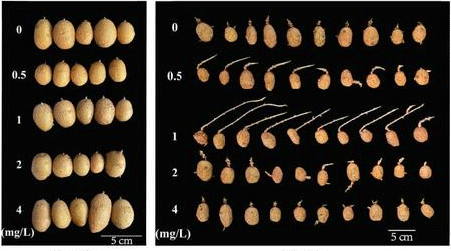
Potato dormancy has long presented farmers and storage managers with a frustrating dilemma: tubers that sprout too early become unmarketable, while those that remain dormant too long delay planting and reduce the growing season. Research from Gansu Agricultural University, published in Horticulture Research, has now identified a key genetic regulator that could solve this centuries-old problem. The study reveals that a specific microRNA, stu-miR319c, acts as a master switch controlling the transition from dormancy to sprouting. By analyzing over 275 million high-quality small RNA sequencing reads, researchers discovered that this microRNA targets and degrades two transcription factors (StTCP26 and StTCP27), while simultaneously activating jasmonic acid pathways that promote sprouting.
The Science Behind the Discovery and Its Practical Implications
The research provides compelling experimental evidence of stu-miR319c’s role. Transgenic potato lines with overexpressed stu-miR319c sprouted significantly earlier than wild-type potatoes, while suppressing its expression delayed sprouting. Furthermore, treatment with methyl jasmonate (MeJA at 1 mg/L) accelerated sprouting by nearly nine days, confirming the hormonal pathway’s involvement. This precise understanding of the dormancy mechanism at the molecular level is a game-changer for potato breeding and storage management. As Dr. Ning Zhang, the study’s senior author, stated, “Potato dormancy is a double-edged sword… Our discovery of stu-miR319c as a regulatory hub provides a genetic tool to balance these competing needs.”
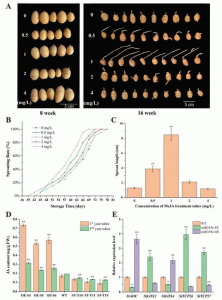
The potential impact of this discovery is substantial when considering global post-harvest losses. The Food and Agriculture Organization (FAO) estimates that 20-25% of potato crops are lost post-harvest in many developing countries, with premature sprouting being a significant contributor. In economic terms, this represents billions of dollars in lost value annually across the global potato industry, which produces over 370 million tons of potatoes each year. By enabling the development of varieties with optimized dormancy periods, this research could significantly reduce these losses while giving farmers greater flexibility in their planting schedules and market timing.
A New Era of Precision in Potato Management
The identification of stu-miR319c represents a paradigm shift in how we approach potato dormancy. Rather than relying on environmental controls and chemical treatments to manage sprouting, breeders can now work toward developing varieties with built-in, genetically programmed dormancy characteristics tailored to specific production systems and market needs. This discovery opens the door to truly customized potato varieties—some with extended dormancy for long-term storage and export markets, others with shortened dormancy for regions with double-cropping systems.
For the agricultural community, this breakthrough underscores the growing importance of molecular biology in addressing practical farming challenges. As climate change and supply chain disruptions continue to threaten food security, such fundamental research provides the tools needed to build more resilient and efficient agricultural systems. The stu-miR319c discovery not only offers immediate promise for potato improvement but also establishes a framework for understanding dormancy mechanisms in other important crops, potentially revolutionizing storage management across multiple agricultural sectors.