Orenburg’s “Boguslavsky” cooperative: how to grow potatoes under 45–50 °C and hot dry winds. Night irrigation, heat-tolerant varieties, 25 kg bags, year-round staffing, and family succession.
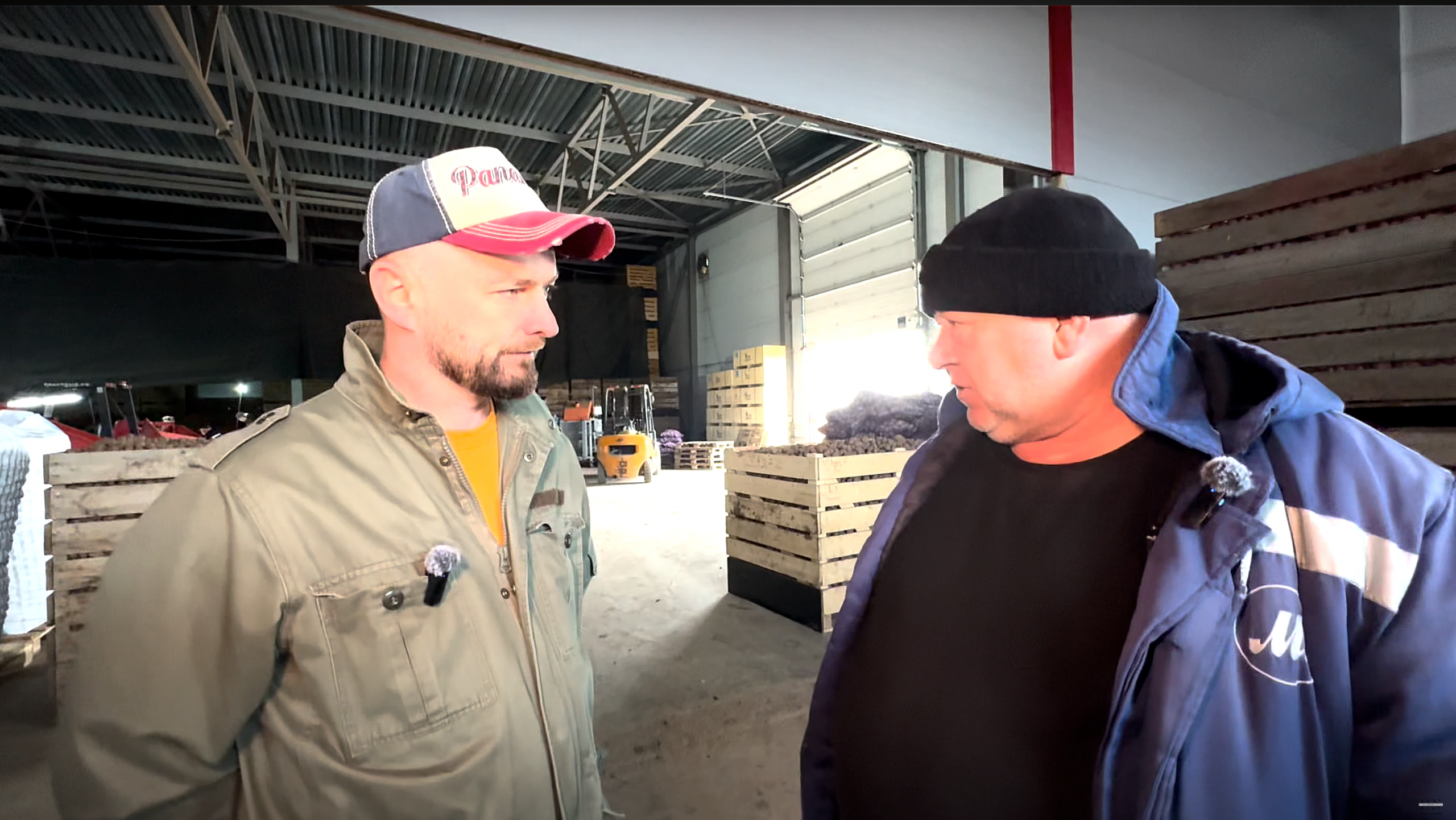
Orenburg steppe, hot dry winds, and the “watermelon capital” — here, potatoes demand a special temperament. The production cooperative “Boguslavsky” started in the 2010s with just 10 hectares and watermelons. Today it’s a family-run farm operating about 1,500 ha, building a resilient vegetable system in an extremely hot climate.
“We have steppe, sukhovei (hot, desiccating winds), and 45–50 °C in summer. That’s a plus for watermelon and a constant stress for potatoes. So we irrigated at night to cool fields and picked varieties that can take the heat,” the team explains.
Region & Beginnings: a Watermelon Heartland and Family Backbone
- The area is known as a center of cucurbit production: “they plant more watermelon here than in many southern regions.”
- Last season hit watermelons hard: rains + logistics — part of the crop couldn’t be hauled in time, and growers lost out.
- It’s a family enterprise: dig a little and “everything is ours.” Children — and even grandchildren — are involved: summer shifts on machines and sorting lines, “teaching love for the land.”
Potatoes: Coping With Heat
- Agro-tech: night irrigation; gradual move from hose-reel sets to modern irrigation machines; careful ridge work to avoid damage from surface watering.
- Varieties (farm-tested): Columbia, Korolevan, Ortlen — “tolerate heat better,” show stress resistance.
- Seed: part from trusted suppliers (“from Andrey”), part own grading/selection.
- Fields & water: center-pivot circles 750–900 m; water from 35–40 m boreholes, “slightly saline but workable.”
Cropping & Economics
- Besides potatoes: peas and barley in the rotation.
- Grain prices, according to the farmers, haven’t covered costs for two seasons (barley cited around ≈5,800 ₽/t — “below cost”).
- Potatoes go mainly to the local retail market: households cellar them and closely watch quality and storability “through June–August.”
- 25 kg bags instead of traditional 36–40 kg string-tied sacks: less reliance on loaders and easier for older buyers to carry into root cellars.
People: Shortage of Operators & the Year-Round Answer
- An acute shortage of machine operators — “a nationwide story.”
- Boguslavsky’s remedy: year-round employment (not just the seasonal “watermelon spike”) and a stable crew — “when the same people work daily, the rhythm is smoother and the machinery lasts longer.”
Equipment & What’s Next
- Much of the fleet is used but well-kept: “the main thing is care and maintenance.”
- Dream on the horizon: a four-row self-propelled harvester — “expensive but worthwhile; when it works in the field, efficiency is on a different level.”
Competition & “Right-Sized” Growth
- The site is remote from large processors and major players — competition is lower, but the logistics leg bites.
- Growth philosophy: no big leaps — “hold ground for the next 2–3 years, refine quality and technology, don’t chase acreage.”
Key Facts From the Visit
- Where: Production Cooperative “Boguslavsky,” Orenburg Oblast.
- Area: about 1,500 ha in rotation.
- Climate factor: hot dry winds, 45–50 °C → night irrigation.
- Potato varieties: Columbia, Korolevan, Ortlen (farm-rated as more heat-tolerant).
- Sales: local market; focus on storability through summer.
- Packaging: 25 kg — convenient for private buyers.
- Labor: shortage of operators; priority on year-round jobs.
- Water: boreholes 35–40 m, mild salinity.
- Plans: tech upgrades (self-propelled harvester), no aggressive expansion.
“We’re not alone. There are people who want to plant and feed the country. When labor starts paying, you go to work like to a celebration, not to hard labor.”