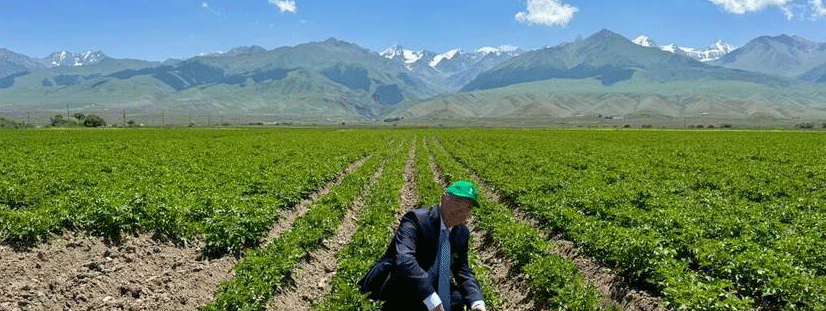
Central Asia’s growing demand for quality seed potato, compounded by logistical disruptions from the war in Ukraine, has catalyzed a strategic rethinking of local production. At the center of this shift is Kyrgyzstan, whose high-altitude valleys are now the site of an ambitious agro-development project. With support from Dutch expertise and EU funding, the country is transforming from a subsistence producer into a potential net exporter of certified seed, aiming to supply markets across Kazakhstan and Uzbekistan.
The foundation of this ambition is Kyrgyzstan’s innate agronomic advantage. The high-altitude regions of Chuy, Naryn, Issyk-Kul, and Osh provide a cool continental climate with minimal viral pressure, a critical factor for producing healthy, disease-free seed potato. This natural “clean slate” is a priceless asset in seed multiplication. While local yields have already shown a remarkable increase—quadrupling from 17 tons/ha to 40 tons/ha in recent decades due to improved varieties—new initiatives are pushing these limits even further. Impressive farmer success stories, including yields of 53 tons/ha for the Dutch variety ‘Camelia’ in Osh, demonstrate the latent potential being unlocked.
The engine of this transformation is the strategic EU and KfW-funded Value Chain Agro Finance project, executed in partnership with the Dutch embassy, seed company HZPC, and local agri-holding Agrolead. The project’s core innovation is the establishment of a local quality control system, modeled on the rigorous Dutch NAK certification protocol. This system ensures that seed produced on 25 hectares of trial fields in Naryn—featuring varieties like Camelia, Colomba, and Challenger—meets international standards through strict adherence to crop rotation, drip irrigation, and precise fertigation.
This move towards local certified seed production is a direct response to a critical market need. The logistical challenges of importing Dutch seed have created bottlenecks, even as demand in Central Asia grows. By establishing in-country production of Super-Elite and Super-Super Elite classes of seed, Kyrgyzstan is building a more resilient and cost-effective supply chain. This is of strategic importance; the FAO consistently highlights that access to quality seed is the primary driver of productivity, and regional food security depends on robust local seed systems.
Kyrgyzstan’s nascent seed potato sector represents a powerful model of successful international agricultural partnership. It effectively combines innate geographical advantages with cutting-edge Dutch agronomy, certification standards, and knowledge transfer. For farmers and agribusinesses across Central Asia, this initiative promises a future with greater access to affordable, high-quality planting material, directly translating to higher yields and income. For global seed companies and policymakers, it demonstrates how leveraging local potential through technology transfer and capacity building can create sustainable, market-oriented agricultural systems that enhance regional food security and trade. Kyrgyzstan is not just growing potatoes; it is cultivating strategic independence and regional leadership.