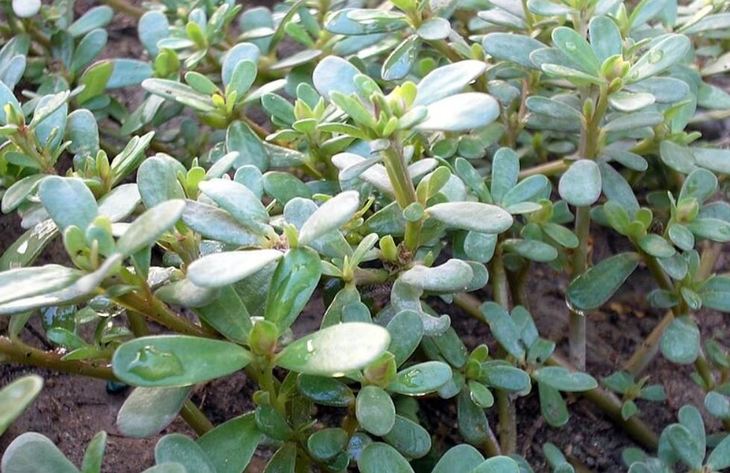
Purslane has provided scientists with important clues on how to create drought-tolerant crops in a world suffering from climate change.
Yale scientists report that the widely distributed and considered weed plant Portulaca oleracea, known as purslane, combines two different metabolic pathways to create a new type of photosynthesis that allows the weed to withstand drought while remaining highly productive. in Science Advances.
“It’s a very rare combination of traits that has produced a sort of ‘super plant’ that is potentially useful in endeavors such as growing crops,” says Erica Edwards of Yale University, professor of ecology and evolutionary biology and senior author of the study.
Plants have independently evolved many different mechanisms to improve photosynthesis, the process by which green plants use sunlight to synthesize nutrients from carbon dioxide and water.
For example, corn and sugarcane have evolved something called C4 photosynthesis, which allows the plant to remain productive at high temperatures.
Succulents, such as cacti and agaves, have another type called CAM photosynthesis, which is essential for survival in deserts. Both C4 and CAM serve different functions but use the same biochemical pathway to act as “additions” to normal photosynthesis.
What makes purslane unique is that it has both of these evolutionary adaptations, allowing it to be both highly productive and very drought tolerant, an unlikely combination.
The Yale University team performed a spatial analysis of gene expression in purslane leaves and found that C4 and CAM activity are fully integrated. They act in the same cells, and the products of CAM reactions are processed by C4. This system provides an unusually high level of C4 plant protection during drought.
The researchers also built metabolic flow models that predicted the emergence of an integrated C4+CAM system, reflecting their experimental results.
The authors say that understanding this new metabolic pathway will help scientists develop new ways to grow crops like corn so they can withstand prolonged drought.
“In terms of developing a CAM cycle for a C4 crop like corn, there is still a lot of work to be done before it becomes a reality,” says Edwards. “But we have shown that the two pathways can be effectively integrated, which makes us suspect that there are many more C4+CAM species waiting to be discovered.”