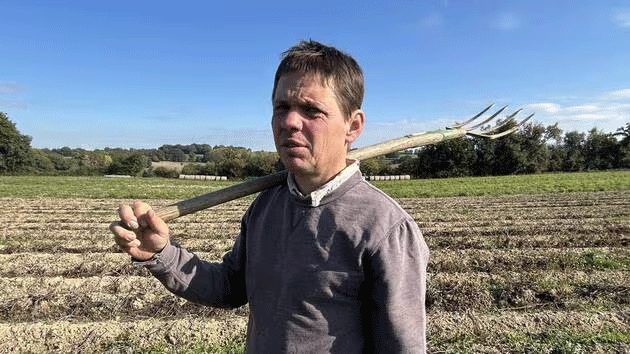
For Valéry Beucher, an organic grower in France’s Mayenne region, the equation is simple. “Without irrigation, potato production has no future in Mayenne,” he states, after watching the adjacent 4,000 m³ pond drop by 30 centimeters during the dry spells of June and July 2025. His experience is not an isolated anecdote but a microcosm of a systemic challenge facing potato producers across the globe. As climate volatility increases, the industry must confront the reality that the potato, with its shallow root system, is uniquely vulnerable to drought, making strategic water management a non-negotiable component of modern agriculture.
The On-Farm Reality: Yield at Risk
Valéry Beucher’s operation provides a clear case study. Farming three hectares, his annual production of 25 tonnes of potatoes is contingent on what he calls “good years.” This equates to a yield of approximately 8.3 tonnes per hectare. For context, this is below the average for organic systems, underscoring the sensitivity of his production to environmental stress. The 2025 season highlighted a critical vulnerability: even in a region not traditionally associated with severe aridity, the timing of drought—during the crucial tuber bulking stage in June and July—directly threatens both yield and quality, making irrigation not just a tool for maximizing output, but for ensuring basic crop survival.
The Global Data: A Thirsty Crop in a Water-Stressed World
The potato’s susceptibility to water stress is well-documented in scientific literature. Research consistently shows that even moderate drought stress can reduce potato yields by 30-50%, and severe stress can lead to total crop failure. Furthermore, water deficit doesn’t just impact tonnage; it causes a range of quality defects, including knobbiness, growth cracks, and elevated levels of reducing sugars, which lead to undesirably dark-colored chips and fries.
Globally, the agricultural sector consumes about 70% of the world’s freshwater, and the competition for this resource is intensifying. A 2023 report by the FAO on water scarcity in agriculture highlighted that climate change is altering precipitation patterns, leading to more frequent and intense dry spells even in temperate regions like Western Europe. This validates Beucher’s experience and suggests that his local challenge is part of a broader, unsettling trend.
Beyond the Sprinkler: The Imperative for Efficient Irrigation
The solution is not simply to turn on the water. The future lies in transitioning from traditional, often wasteful, irrigation methods to precision agriculture. This involves:
- Scheduled Deficit Irrigation: Applying water strategically during the most drought-sensitive growth stages, particularly during tuber initiation and bulking.
- Drip Irrigation: While less common in broad-acre potato production, subsurface drip irrigation is gaining traction for its ability to deliver water directly to the root zone, minimizing evaporation and runoff. Studies have shown it can improve water use efficiency by up to 30% compared to overhead sprinklers.
- Soil Moisture Monitoring: Using sensors and telemetry to guide irrigation decisions based on real-time soil water potential, rather than a fixed schedule.
Valéry Beucher’s warning from Mayenne is a canary in the coal mine for potato producers worldwide. Relying on rainfall alone is becoming an increasingly risky, and often unviable, strategy. The future of potato cultivation depends on a fundamental shift in approach, where water is recognized as a primary, limiting input. Success will belong to those who integrate advanced irrigation management—supported by precise scheduling and efficient technology—into their core operational strategy. This is no longer merely about optimizing yield in good years; it is about securing a harvest in the face of the increasingly volatile and arid “new normal.”