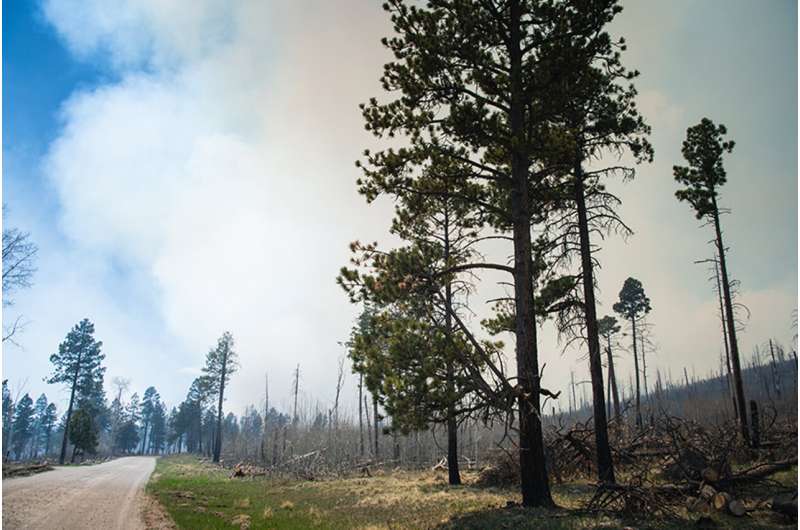
A new conceptual framework for incorporating the way plants use carbon and water, or plant dynamics, into fine-scale computer models of wildland fire provides a critical first step toward improved global fire forecasting.
“Understanding the influences of vegetation structure and physiology on wildland fire is crucial to accurately predicting the behavior of fire and its effects,” said L. Turin Dickman, a plant ecophysiologist at Los Alamos National Laboratory. Dickman is corresponding author of a paper on plants and fire modeling in the journal New Phytologist. “Our research can be used to improve models that fire managers need to navigate an uncertain future.”
In the paper, an international research team found that the water and carbon dynamics of plants, which influence combustion and heat transfer in the plant and often dictate its survival, provide the mechanism linking fire behavior to plant injury, mortality and recovery.
These findings emphasize the importance of accounting for plant physiology and water use in wildfire forecasting and also in prescribed fire planning, where the moisture levels of fuels greatly influence how the fire burns.
Closing the gap in modeling
Drought and elevated temperature are compounding water stress in plants, stoking the role of vegetation dynamics in fire behavior, Dickman said.
“Wildfires are a global crisis, and plants are responding physiologically to drought and warming,” Dickman said. “Current fire models fail to capture vegetation response to changing climate, but next-generation models can simulate increasingly complex physical processes. So our approach will be essential to enable models to simulate the influence of those responses on live-fuel conditions.”
Fires burn more forests and shrublands in regions where vegetation moisture is more sensitive to limited water. For example, the different ways various evergreen species use water can cause substantial variation in their moisture content. That, in turn, impacts how they burn and whether they survive, the paper noted.