In a significant development for Russian agriculture, Novgorod Oblast has emerged as the leading potato producer in the Northwestern Federal District. This achievement is not a matter of chance but the direct result of a strategic, multi-year focus on developing a self-sufficient, high-tech seed potato sector. The region’s blueprint offers a compelling case study on how targeted investment in foundational agricultural infrastructure—specifically seed systems—can drive tangible production leadership and enhance regional food security.
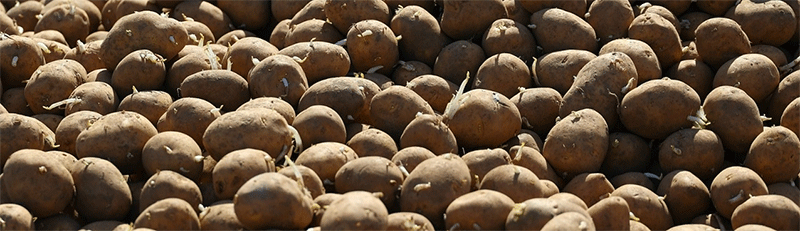
The core of Novgorod’s success lies in its specialized seed farms. With six dedicated facilities, including four focused on primary, virus-free seed propagation, the region is building a pipeline of healthy planting material from the ground up. This focus on quality at the earliest stage is critical. Data consistently shows that using certified, virus-free seed potatoes can increase yields by 30-50% compared to farm-saved seed, while drastically reducing disease pressure and the need for chemical interventions. The recent completion of a modern selection and seed-growing center, with an annual capacity of 6,500 tons, underscores the commitment to scaling this advantage. In 2025, production of elite mini-tubers reached 707,000 units, providing the genetic foundation for future commercial crops. This is supported by a substantial subsidy program, with over 4.7 million rubles allocated in the current year to help producers modernize equipment and skills—a direct financial mechanism to accelerate technology adoption.
Perhaps the most telling metric of this strategy’s success is the region’s performance with domestic varieties. Novgorod farmers planted 5,270.4 tons of domestically bred seed potatoes, smashing the federal target of 4,500 tons by 117%. This shift towards home-grown genetics is a strategic move with national implications. Prior to recent geopolitical shifts and sanctions, Russia imported a significant portion of its elite seed potatoes, particularly for french fry processing varieties. Novgorod’s model of scaling domestic seed production directly addresses this vulnerability, contributing to national food sovereignty. The resulting increase in local production of high-quality seed reduces dependency, insulates farmers from supply chain disruptions and currency volatility, and ensures that a greater portion of the value remains within the regional economy.
Novgorod Oblast’s rise to the top of Northwestern Russia’s potato sector provides a clear and replicable lesson for agricultural regions worldwide: sustainable production leadership is built on the foundation of a robust, technologically advanced seed system. By prioritizing state-supported investments in virus-free propagation, modern seed-growing infrastructure, and incentives for adopting domestic varieties, the region has not only boosted its yield and total output but has also built a more resilient and self-reliant agricultural economy. For farmers, agronomists, and policymakers, the takeaway is that long-term competitiveness and food security begin with the quality of the seed in the ground. Novgorod’s strategy demonstrates that controlling this first link in the agricultural value chain is the most powerful lever for ensuring stability and growth.