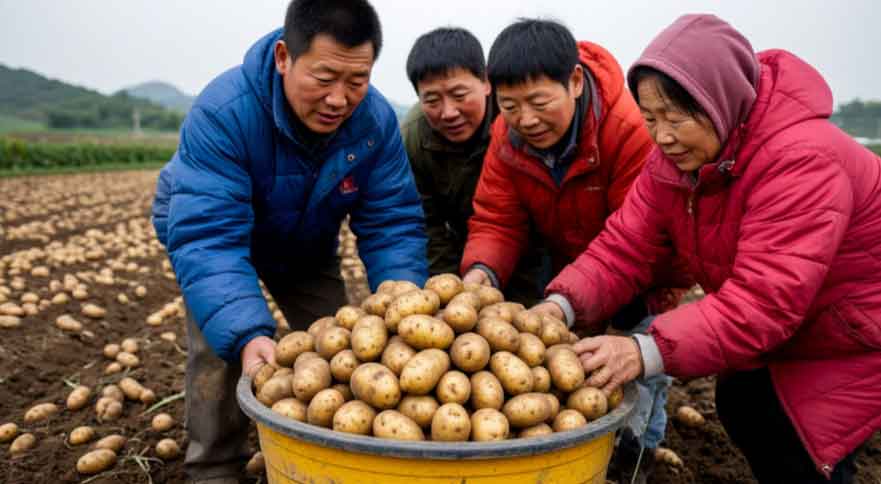
For agricultural development specialists and farming system professionals, Weining Autonomous County’s transformation of its potato sector offers a masterclass in systematic agricultural modernization. With a stable cultivation area of 1.5 million mu (approximately 100,000 hectares), total output reaching 3 million tons, and comprehensive industry value hitting 4 billion yuan ($550 million), Weining has successfully repositioned potatoes from subsistence food to economic driver . The foundation of this transformation rests on three strategic pillars. First, seed system sovereignty: the county operates Southwest China’s largest minituber propagation center, producing 70 million tissue-culture plantlets and over 80 million minitubers annually, ensuring virus-free planting material that has doubled yields from 2,000 to over 4,000 jin per mu . Second, integrated mechanization: with agricultural machinery exceeding 120,000 units and comprehensive mechanization reaching 56.39%, innovations like “internet-enabled农机 services” covering 100,000 mu allow smallholders to access precision planting, drone-based crop protection, and mechanical harvesting—reducing labor from 100 to 20 workdays for a 20-mu plot . The December 2025 establishment of the Guizhou Potato Technology Innovation Center formalizes the research-industry-extension pipeline, focusing on variety breeding, green cultivation, and deep-processing technologies .
The third pillar—value chain integration—has proven equally critical. Weining has shifted from raw tuber sales to diversified product lines including chips, fries, starch, flakes, and fresh-cut vegetables through its 500-mu processing industrial park, which annually processes 50,000 tons of potato flakes, 35,000 tons of fries, and 300,000 tons of fresh potatoes . The “Weining Potato” regional public brand now achieves a reputation index of 801.19 and has been selected for China’s Agricultural Brand Catalog, with protected purchase prices through “company + cooperative + farmer” agreements ensuring stable incomes . Farmers like Zhao Xu in Xue Shan Town benefit from multiple revenue streams: land transfer fees, cooperative dividends, and wages—earning incomes comparable to migrant labor while remaining in their villages . Beyond processing, Weining is pioneering integration with tourism through potato-themed agritourism complexes and harvest experience parks, further expanding value capture . With 5,000-7,000 hectares of suitable winter-spring cropping land still available and domestic processing plants operating at only 30-40% of capacity met by domestic supply, the expansion potential remains substantial. Weining’s systematic approach—integrating seed science, appropriate mechanization for hilly terrain, processing infrastructure, and brand development—offers a replicable template for transforming traditional staple crops into engines of rural revitalization.