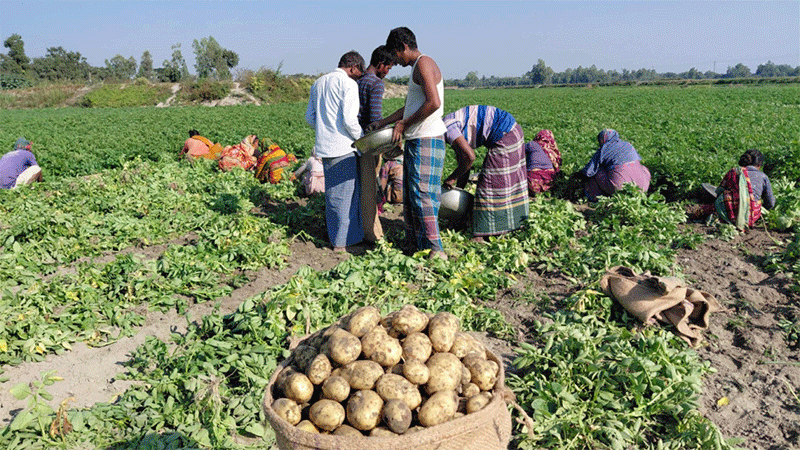
For growers of early-maturing potato varieties, timing is everything. The strategy is simple: beat the main harvest to market, capture premium prices fueled by consumer desire for “new” potatoes, and secure a vital income stream. In Bangladesh this season, that strategy has collapsed. Farmers who planted in early October for a December harvest are facing catastrophic losses, not due to poor yields, but because the market remains saturated with the previous year’s record crop. This crisis exposes the vulnerabilities of a potato sector struggling with systemic overproduction, inefficient market linkages, and soaring input costs.
The core of the problem is a staggering supply imbalance. According to the Bangladesh Cold Storage Association, despite the new harvest, approximately 500,000 tonnes of old potatoes remained in cold storage well past the typical clearance date of December 10. This massive carryover directly cannibalizes the premium market for early potatoes. As noted by retail trader Arif Hossain, “The market is still flooded with old potatoes, which is keeping prices of new ones down.” The data is stark: wholesale prices for new potatoes are Tk 28-30/kg, perilously close to or below the reported production cost of Tk 30/kg. This represents a dramatic collapse from the Tk 60-70/kg price seen for both new and old potatoes in mid-December the previous year. The national context amplifies the issue. Bangladesh produced an estimated 11.5 million tonnes of potatoes last winter against a domestic demand of only 8-9 million tonnes, a structural surplus that cripples prices across the board.
This price crisis is compounded by a sharp rise in production costs and on-farm challenges. Farmer Dilbar Rahman’s experience is emblematic: an investment of Tk 620,000 on 10 bighas of land yielded a return of just Tk 570,000—a loss of Tk 50,000, compared to a Tk 200,000 profit the year before. Adverse weather, including continuous rainfall during planting, increased cultivation risks and costs. Furthermore, experts like Professor Mohammad Jahangir Alam point to macroeconomic headwinds, noting that declining purchasing power amid rising inflation and poverty has suppressed household demand, making it harder to absorb even premium early produce. This creates a perfect storm where farmers achieve good yields only to find the market fundamentally unable to offer a sustainable price, a sentiment echoed by Sirajul Islam of the Department of Agricultural Extension in Rangpur.
The plight of Bangladesh’s early potato farmers is more than a seasonal setback; it is a symptom of deep-seated challenges in agricultural commodity systems. It highlights the critical danger of production strategies disconnected from real-time market intelligence and storage management. The reliance on a “grow more” philosophy, without corresponding advances in processing, export, or diversified demand, leads directly to destructive gluts. For agronomists and farmers globally, this case underscores the non-negotiable need for integrated market planning, strengthened cold chain logistics, and the development of risk-mitigation tools like forward contracts. Sustainable profitability now depends as much on smart marketing and supply chain coordination as it does on achieving high yields in the field. Science must increasingly focus not just on growing more, but on enabling farmers to sell smarter.