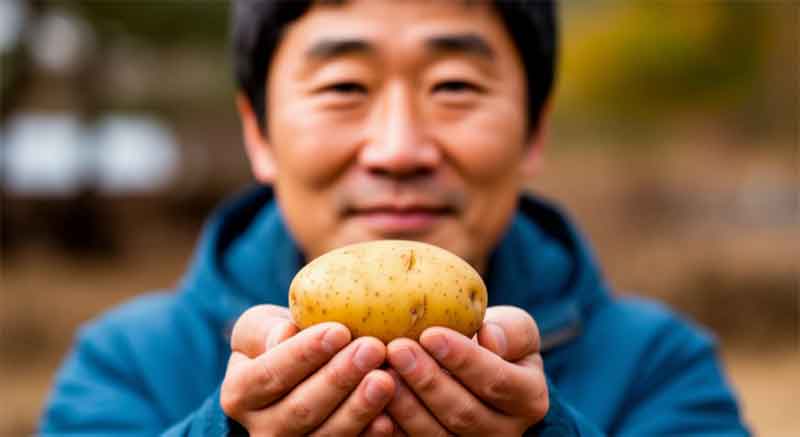
South Korea’s potato sector operates under a paradoxical statistic: annual production reaches 600,000 tons of table stock (“sunshine potatoes”), yet only 60,000–80,000 tons enter chip processing, and virtually zero domestic raw material is used for frozen french fries or starch manufacturing [source text]. The bottleneck is not volume—it is biochemistry. Potato tubers stored at the recommended low temperatures of 2–5°C to suppress sprouting and disease undergo cold-induced sweetening (CIS), a well-characterized physiological disorder in which starch degrades to reducing sugars (glucose, fructose) . Upon high-temperature frying, these sugars react with free amino acids via the Maillard reaction, producing dark, bitter, and visually unacceptable products . This is not spoilage; it is a metabolic response that renders perfectly edible potatoes commercially unfit for processing. The condition is so prevalent that the Korean term “pae” describes the translucent, glassy flesh of chilled potatoes, and culinary guides now include protocols for salvaging such tubers through blanching—a workaround, not a solution .
The structural consequence is a predictable import window. From December through April, domestic processing capacity collapses, and seasonal tariffs on U.S. and Australian processing potatoes have historically filled the gap [source text]. But that mechanism expires decisively: under the Korea-U.S. FTA, year-round tariffs on U.S. processing potatoes disappear in 2026; under the Korea-Australia FTA, the same occurs in 2028 [source text]. The transition is not impending—it is present. Yet the domestic innovation pipeline remains obstructed. J.R. Simplot’s GMO potato SPS-Y9, engineered specifically to resist CIS and bruising, requested Korean import approval in April 2018 . It received environmental risk clearance from the Rural Development Administration only in February 2025—seven years later . It now awaits final food safety assessment by the Ministry of Food and Drug Safety, with no guaranteed completion date. Industry experts and the American Chamber of Commerce in Korea attribute this delay to a fragmented five-ministry review system where non-specialists request irrelevant supplementary materials and duplicated procedures, creating what trade partners classify as a non-tariff barrier .
Simultaneously, public-sector varietal development has not delivered commercial-scale processing alternatives. While South Korea maintains a ban on domestic GMO cultivation, conventional breeding for heat-tolerant, CIS-resistant, early-maturing processing varieties remains nascent. The source text’s call for “accelerated development and dissemination of processing varieties” reflects a current vacuum. Meanwhile, neighboring China’s research apparatus has published comprehensive 2024 reviews on starch-sugar metabolism pathways and molecular breeding strategies for CIS tolerance, including exogenous phytohormone applications and gene-editing targets . South Korea’s last indexed study on frozen potato storage quality dates to 2007 .
There are, however, structural investments occurring in parallel. Jeollanam-do, in collaboration with the Ministry of Agriculture, Food and Rural Affairs, is executing a 228 billion KRW (approx. $170 million USD) Smart Agricultural Product Distribution and Storage Technology Development Project running through 2026 . Its mandate includes robotics-based automated sorting, storage optimization, and supply chain digitalization for onions, sweet potatoes, and apples—but notably, not processing potatoes . While valuable for post-harvest efficiency, this initiative does not address the core biological constraint of CIS or the absence of frying-grade raw material.
The source text quotes Dr. Cho Kwang-soo, Director of the National Institute of Food Science, emphasizing that “stable domestic potato supply under accelerating import liberalization extends beyond industrial protection to the level of food security.” This is not rhetorical. If by 2028 domestic processors cannot source local raw material meeting fry-grade color and dry matter specifications, the entire french fry and starch manufacturing chain will operate on permanent import dependency. Contract farming programs, varietal royalties, and on-farm mechanization investments will flow exclusively to overseas suppliers.
South Korea’s processing potato dilemma is not a market access problem—it is a bioscience delivery failure. The 2026–2028 window is not a negotiation phase; it is a physiological deadline. The industry requires, within 24 months, deployable processing varieties—whether via accelerated conventional breeding, fast-tracked environmental release of CIS-resistant biotech potatoes, or strategic imports of certified early-generation seed for multiplication. Simultaneously, the LMO approval system requires structural consolidation to a single lead agency with binding timelines, as proposed by experts at Seoul National University and the University of Science and Technology . Without parallel breakthroughs in regulatory efficiency and varietal availability, the tariff phase-out will not stimulate domestic competitiveness—it will merely finalize import substitution. For the Korean potato grower, the question is no longer whether to compete with U.S. and Australian processing potatoes. The question is whether, by 2028, they will have a product that can legally and agronomically enter the same fryer.