According to Minister of Agriculture and Food Yuri Gorlov, Belarus is anticipating a significant agricultural recovery, with a potato harvest projected to reach 1 million tons—a 30% increase over 2024 levels. This rebound follows spring frosts that damaged early crops and orchards, illustrating the ongoing volatility faced by producers. The nation’s approach, however, extends beyond mere production, showcasing a deeply integrated system of state planning, strategic reserves, and trade mechanisms designed to ensure domestic market stability.
This recovery is not left to chance. It is underpinned by the “Comprehensive Plan for the Development of Fruit and Vegetable Growing for 2025-2030,” which sets specific production targets by year and region. This planned approach aims to systematically ramp up output and diversify the range of produce, with a particular focus on high-demand items like early potatoes and apples.
The Infrastructure of Food Security: Reserves and Domestic Machinery
A critical component of Belarus’s strategy is the creation of stabilizational food reserves. For the 2025-2026 season, the state plans to store 149,000 tons of key produce. This includes:
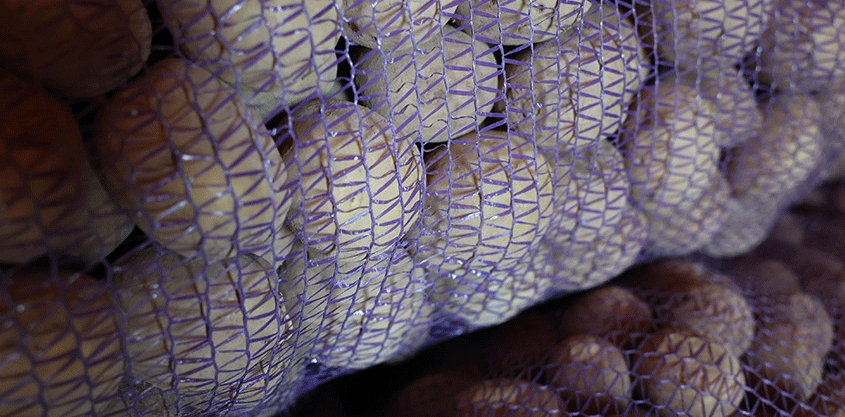
- 59,000 tons of potatoes (6% of the projected harvest)
- 63,000 tons of vegetables (11% of the harvest)
- 27,000 tons of apples (a significant 40% of the reduced apple crop)
These reserves act as a buffer against price shocks and seasonal shortages, a practice supported by global food security research. The FAO consistently emphasizes the role of strategic food reserves in mitigating the impact of production shortfalls and ensuring continuous supply.
Furthermore, Minister Gorlov highlighted the role of domestic infrastructure, noting that 87% of the machinery and tractor fleet in agricultural organizations is comprised of Belarusian equipment. This reliance on a local manufacturing base aims to insulate farmers from global supply chain disruptions and ensure timely access to parts and service for the critical harvest period.
Managing Deficits through Trade Policy
The approach to the apple harvest, projected to be lower at 80,000 tons, demonstrates the state’s willingness to intervene in trade to protect domestic supply. The continuation of export licensing for apples is a form of non-tariff regulation, a tool used to prioritize the home market. This practice, while controversial in free trade circles, is a direct method for a nation to control the outflow of a commodity in short supply, ensuring that “internal trade organizations” are fully supplied through direct contracts with producers.
The Belarusian model presents a distinct paradigm in agricultural management. It combines ambitious production targets with a robust safety net of strategic reserves and does not hesitate to use trade levers to correct for market deficits. For global agricultural professionals, it serves as a powerful example of a highly coordinated, state-centric approach to food sovereignty. While the reliance on central planning and export controls may differ from market-driven models, its effectiveness in ensuring a stable supply of staple crops like potatoes for the domestic market is a key outcome that cannot be ignored. The success of this system hinges on the precise execution of its plans and the continued investment in the domestic agricultural infrastructure that supports it.