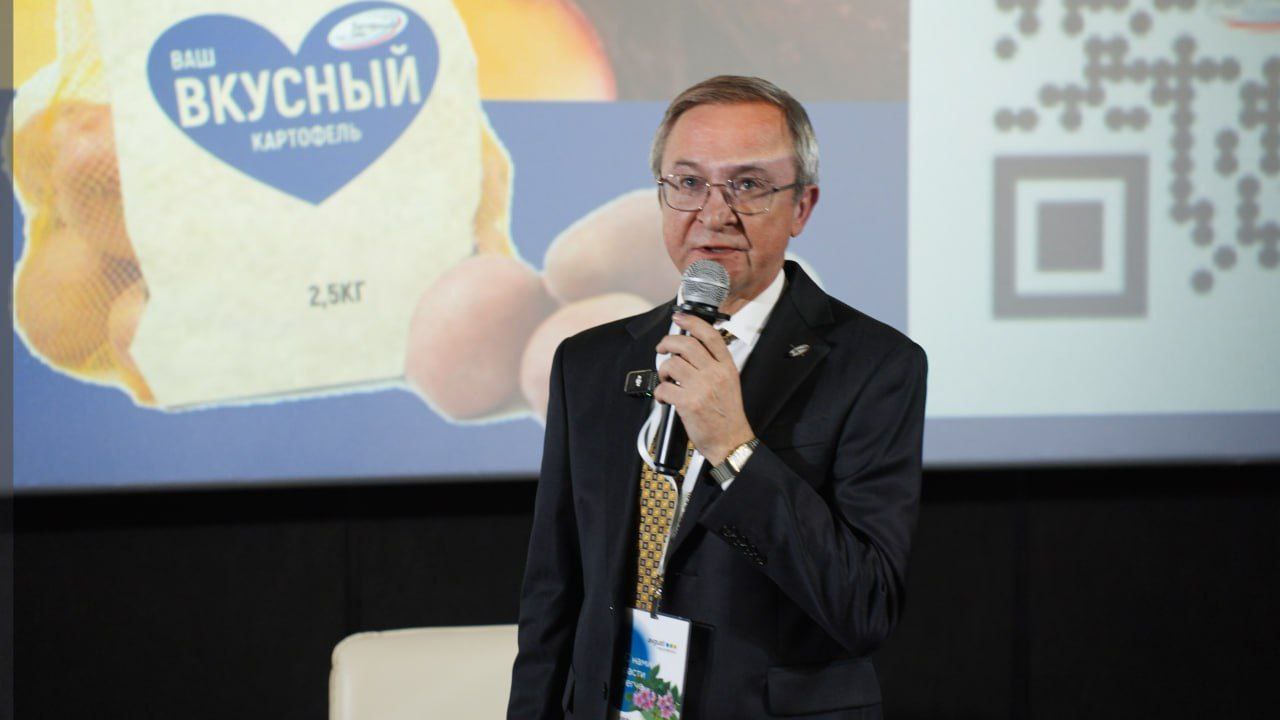
Cheboksary, March 4-5, 2026 — As part of the XVIII Interregional Industry Exhibition “Potato-2026”, leading market players, breeders, and agribusiness representatives traditionally gathered. One of the key events of the business program was the speech by Alexey Krasilnikov, Executive Director of the Potato Union, who presented a detailed cross-section of the current state of the industry, pointed out pain points, and outlined development vectors until 2030.
Specifically for the potatoes.news portal, we have prepared an extended review of the Potato Union’s analytics presented during the international potato tour.
Threefold Growth and Record Harvests
Since the beginning of the century, the organized potato production sector (agricultural organizations, peasant farms, and individual entrepreneurs) has grown almost threefold. As Alexey Krasilnikov emphasized, this growth was achieved not through an extensive increase in sown areas, but thanks to intensification: the introduction of new technologies, improving the quality of planting material, and increasing crop yields.
Following the abnormal drought of 2010, when the gross harvest dropped to 3.3 million tons, the industry has done a colossal amount of work. In 2023, a record figure was achieved — 8.62 million tons. The forecast for 2026, according to conservative estimates of the Ministry of Agriculture of the Russian Federation, is about 7.96 million tons.
Dynamics of Sown Areas and Gross Harvest (Industrial Sector)
| Year | Sown Area (thous. ha) | Gross Harvest (thous. tons) | Yield (c/ha) |
| 2010 | 357.9 | 3,388.9 | 130.7 |
| 2020 | 282.7 | 6,811.1 | 250.6 |
| 2023 | 313.7 | 8,624.9 | 290.0 |
| 2024 | 281.2 | 7,299.5 | 270.2 |
| 2025 | 279.6 | 8,469.8 | 310.8 |
| 2026 (forecast) | 285.6 | 7,965.6 | 278.9 |
With an average consumption of 54 kg of potatoes per person per year, current production volumes allow providing for 95% of the domestic market and open up opportunities for export and deep processing.
Processing: The Main Growth Driver
Under the conditions of high harvests, processing becomes the main mechanism for market stabilization. While about 1.6 million tons of raw materials went into processing in 2020, by 2026, according to Potato Union forecasts, this figure will reach 3.4 million tons.
French fries and chips remain the key directions. New large-scale projects are being launched (in particular, in the Orel and Kaliningrad regions, as well as in Tatarstan), which, despite delays in implementation schedules, will seriously increase the demand for specialized raw material varieties in the coming years. However, as experts note, the growth of processing has hit a wall due to the lack of a loyal customs and tariff policy on the part of the Russian Federation, leaving the market absolutely unprotected.
Forecast of Potato Processing Development (in terms of raw materials)
| Product Type | 2020 (thous. tons) | 2026 – forecast (thous. tons) |
| French Fries | 400 | 1000 |
| Chips | 500 | 1000 |
| Flakes | 500 | 900 |
| Starch | 200 | 500 |
| TOTAL: | 1600 | 3400 |
Breeding and Seed Production: The Battle for Sovereignty
One of the most pressing topics of the exhibition was the dependence on foreign breeding. There are more than 530 potato varieties listed in the State Register of the Russian Federation, however, the top 10 varieties (Gala, Lady Claire, Innovator, Colomba, etc.) account for about 60% of all planted areas.
In the top 20 of certified seed potatoes, domestic varieties occupy only 7% (Sadon, Nevsky, Flamingo). At the same time, the state sets strict indicators: according to a decree of the Government of the Russian Federation, by 2030, the share of domestically bred potato seeds must reach 35%.
In 2026, the Ministry of Agriculture set plans for sowing domestic seeds. Thus, in the Volga Federal District, it is planned to plant more than 22 thousand tons (of which 4,556 tons in the Nizhny Novgorod region, 2,743 tons in Tatarstan, and 1,887 tons in Chuvashia). Great hopes are pinned on new domestic varieties, such as Sadon (a joint development by the Lorkh Institute and the Fat-Agro company).
Storage Infrastructure: The Deficit Persists
Where to store the harvested potatoes? According to the Ministry of Agriculture, at the end of 2025, the total capacity of potato and vegetable storage facilities was about 9.38 million tons (of which more than 3,300 facilities are functioning).
However, taking into account the production of ~8 million tons of potatoes and more than 5 million tons of vegetables, the industry is experiencing a storage capacity deficit of 1.8 – 2 million tons. About 300 thousand tons of new capacities are commissioned annually. The state stimulates this process: since 2024, subsidies are provided to compensate for part of the direct costs of modernizing and creating modern storage facilities with climate control (up to 37,000 rubles, or about $410, per ton of capacity).
Import and Export: A Complex Balance
Despite a high level of self-sufficiency, Russia remains integrated into the global market. In the spring-summer period, supplies of early potatoes are traditionally carried out. Imports from Belarus are usually insignificant; however, this year, at the beginning of February, a record figure of 14 thousand tons was recorded. Experts suspect that European tubers are being supplied under the guise of Belarusian ones. In 2025, total imports of table potatoes amounted to more than 930 thousand tons (a significant increase against the background of zeroed import duties).
At the same time, the export of domestic potatoes faced difficulties. Due to regulatory restrictions and problems with phytosanitary certificates, exports in 2025 dropped by almost three times, amounting to only 207 thousand tons (main buyers — Kazakhstan, Uzbekistan, Azerbaijan).
Consumer Barometer: When Will Russians Go Plant Potatoes?
An interesting addition to the analytics was a study by the “Omnibus SocioLife” agency. Amidst price fluctuations, respondents were asked the question: “At what price for 1 kg of potatoes would you decide to grow them yourself?”
- 46% of city dwellers stated that they would not grow potatoes under any circumstances (they don’t care about the store price).
- 25.5% — are already growing potatoes on their plots.
- 15.9% — are ready to plow their flower beds and return to their vegetable gardens if the price breaks the psychological mark of 123 rubles (about $1.37) per kilogram.
Interestingly, the largest share of “independent” potato growers lives in the Far East (45%), while the smallest is in megacities (Moscow, St. Petersburg — about 14%).
Conclusion
The “Potato-2026” exhibition in Cheboksary showed: the Russian potato sector is a high-tech, dynamically developing industry. There are serious challenges ahead: import substitution in breeding, increasing storage capacities, and developing processing. But, as the numbers show, the foundation for overcoming these challenges has already been laid, and potatoes rightfully remain a reliable “second bread” for the country.
Specifically for potatoes.news based on materials from the Potato Union.