• About Us
  • Partnership & Advertising Opportunities
  • Careers at Potatoes.News
Saturday, January 10, 2026
  • Login
  • Register
No Result
View All Result
POTATOES NEWS
  • NEWS
  • IPT
  • AGROTECHNOLOGY
  • IRRIGATION
  • POTATO PROCESSING
  • Contact us
  • NEWS
  • IPT
  • AGROTECHNOLOGY
  • IRRIGATION
  • POTATO PROCESSING
  • Contact us
No Result
View All Result
POTATOES NEWS

Silver Scurf (Helminthosporium solani)

by T.G. Lynn
15.12.2022
in AGROTECHNOLOGY
A A
Silver Scurf (Helminthosporium solani)

Pathogen. The silver scurf fungus overwinters mainly on infected seed tubers. It can also survive for at least one year on decaying organic matter in the soil, indicating that soil may be a source of inoculum.

On infected tubers, the fungus produces spores only at the edges of the lesions. Thus, seed tubers with the surface completely covered by silver scurf do not spread the disease because the fungus cannot produce spores.

Disease development. Spores produced on seed tubers wash onto new tubers. Infection takes place through lenticels and directly through the
skin. The infection remains confined to the skin tissue, causing it to loosen. Air trapped under the loosened skin reflects light, resulting in the silvery sheen typical of infected potatoes.

Silver scurf lesions may be difficult to detect at harvest, particularly if the tubers are not washed. Disease incidence increases when potatoes are left in the ground after maturity and are harvested late. High humidity in the fall also increases silver scurf damage.
In storage, the tubers lose water through the lesions, so some shriveling and wrinkling may occur.

Spores produced on infected tubers spread the disease in storage. High humidity is essential for the spread of silver scurf in storage.
Primary infections or tuber infections initiated in the field usually develop at the stem end of the tuber. By contrast, secondary infections or tuber infections that develop in storage may cover a major portion of the tuber and start as dark-brown to black, circular lesions on several areas of the tuber.
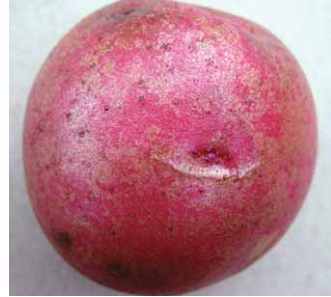
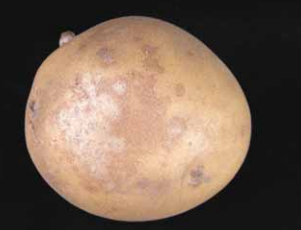
Silver scurf lesion at the stem end of the tuber
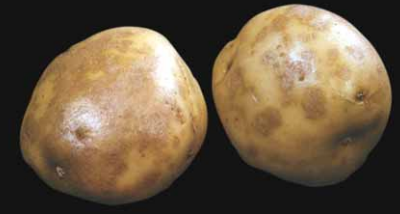
Silver scurf lesions on a red variety.
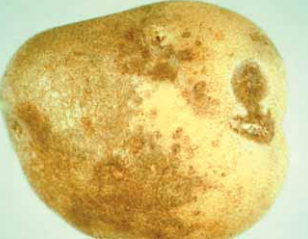
| Occasionally, silver scurf (left) and black dot
(right) develop оn the same tuber.
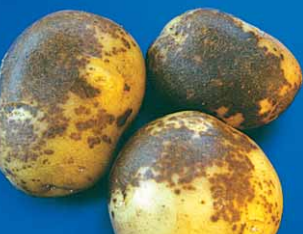
236     Small or large circular or irregular spots of silvery appearance. The silvery appearance is more noticeable when the tubers are wet.
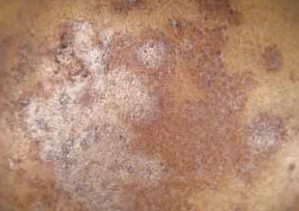
Close-up view of silver scurf and black dot lesions.
Tags: Helminthosporium
Next Post
The Ministry of Agriculture has formed the structure of sown areas for the harvest of 2023

The Ministry of Agriculture has formed the structure of sown areas for the harvest of 2023

General Partner’s position

Recommended

One in 100,000: Breeders in Rhinelander seek the next commercial potato variety

One in 100,000: Breeders in Rhinelander seek the next commercial potato variety

4 years ago
Global Potato Starch Market Set to Surge to $6.7 Billion by 2032: What This Means for Farmers and Processors

Global Potato Starch Market Set to Surge to $6.7 Billion by 2032: What This Means for Farmers and Processors

1 year ago
  • About Us
  • Partnership & Advertising Opportunities
  • Careers at Potatoes.News

© 2010-2026 POTATOES NEWS

Welcome Back!

Login to your account below

Forgotten Password? Sign Up

Create New Account!

Fill the forms below to register

All fields are required. Log In

Retrieve your password

Please enter your username or email address to reset your password.

Log In
No Result
View All Result
  • NEWS
  • IPT
  • AGROTECHNOLOGY
  • IRRIGATION
  • POTATO PROCESSING
  • Contact us

© 2010-2026 POTATOES NEWS