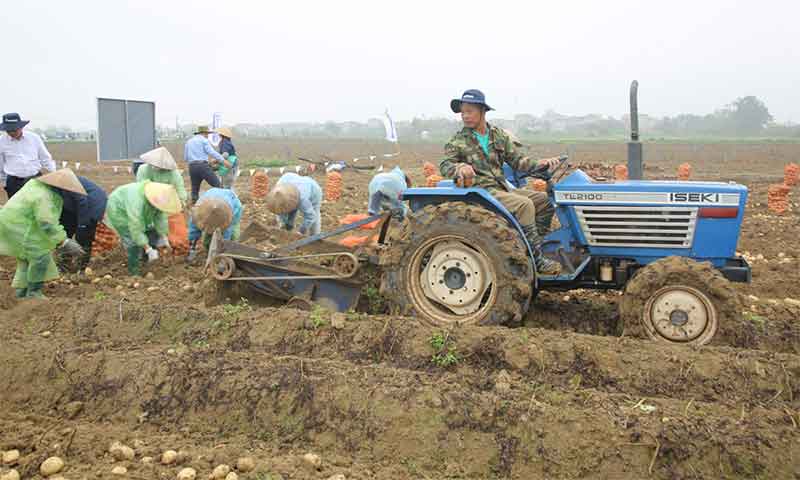
For agricultural scientists and farm management professionals, the winter-spring potato programs in Vietnam’s Bac Ninh province demonstrate how strategic integration of multinational processing companies, precision agriculture technologies, and contract farming can dramatically transform smallholder productivity and profitability. The partnership models implemented by PepsiCo Vietnam and Orion Vina have created a structured pathway for technology transfer and market access that addresses the classic constraints of smallholder agriculture. Farmer Vu Ngoc Huu’s experience with Orion Vina illustrates the foundational benefits: guaranteed purchase at 8,500 VND/kg (approximately $0.34/kg) with timely payment and continuous technical extension support, enabling net returns of 60-90 million VND per hectare from conventional practices . However, the quantum leap comes through the precision agriculture package demonstrated by Doan The Anh’s partnership with PepsiCo, where 50 hectares under high-technology management—including automated fertigation systems, weather stations with smartphone connectivity, and drone-based crop monitoring and crop protection application—achieved yields of 36-37 tons per hectare, representing a 30% increase over traditional methods and generating post-cost profits of 150 million VND per hectare (approximately $6,000) .
The aggregate data confirms this transformation’s scalability. Across Bac Ninh province, contracted potato area is approaching 1,000 hectares for the 2025-2026 winter-spring season, utilizing a sophisticated variety portfolio that segments processing (Atlantic, Bliss) and table-stock (Marabel, Diamant, Eben, Aladin, Actrice) markets . Average contract yields are projected at 18-20 tons per hectare, producing 18,000-20,000 tons annually with gross returns of 120-150 million VND per hectare . Critically, the demand-side economics remain highly favorable: Orion Vina alone requires approximately 60,000 tons of processing potatoes annually, with domestic supply still insufficient to meet processor demand, necessitating continued imports . With total suitable land in Bac Ninh estimated at 5,000-7,000 hectares—particularly concentrated in sandy loam and riverside alluvial areas—the expansion potential is substantial . The model demonstrates that when processors provide guaranteed offtake, competitive pricing, and intensive technical support, and when farmers adopt precision agriculture technologies, the yield gap between traditional and best-practice production can be bridged while simultaneously addressing corporate raw material security and national import substitution objectives. For agricultural development specialists worldwide, Bac Ninh offers a replicable template for transitioning smallholder agriculture toward commercially viable, technology-enabled, market-integrated production systems.