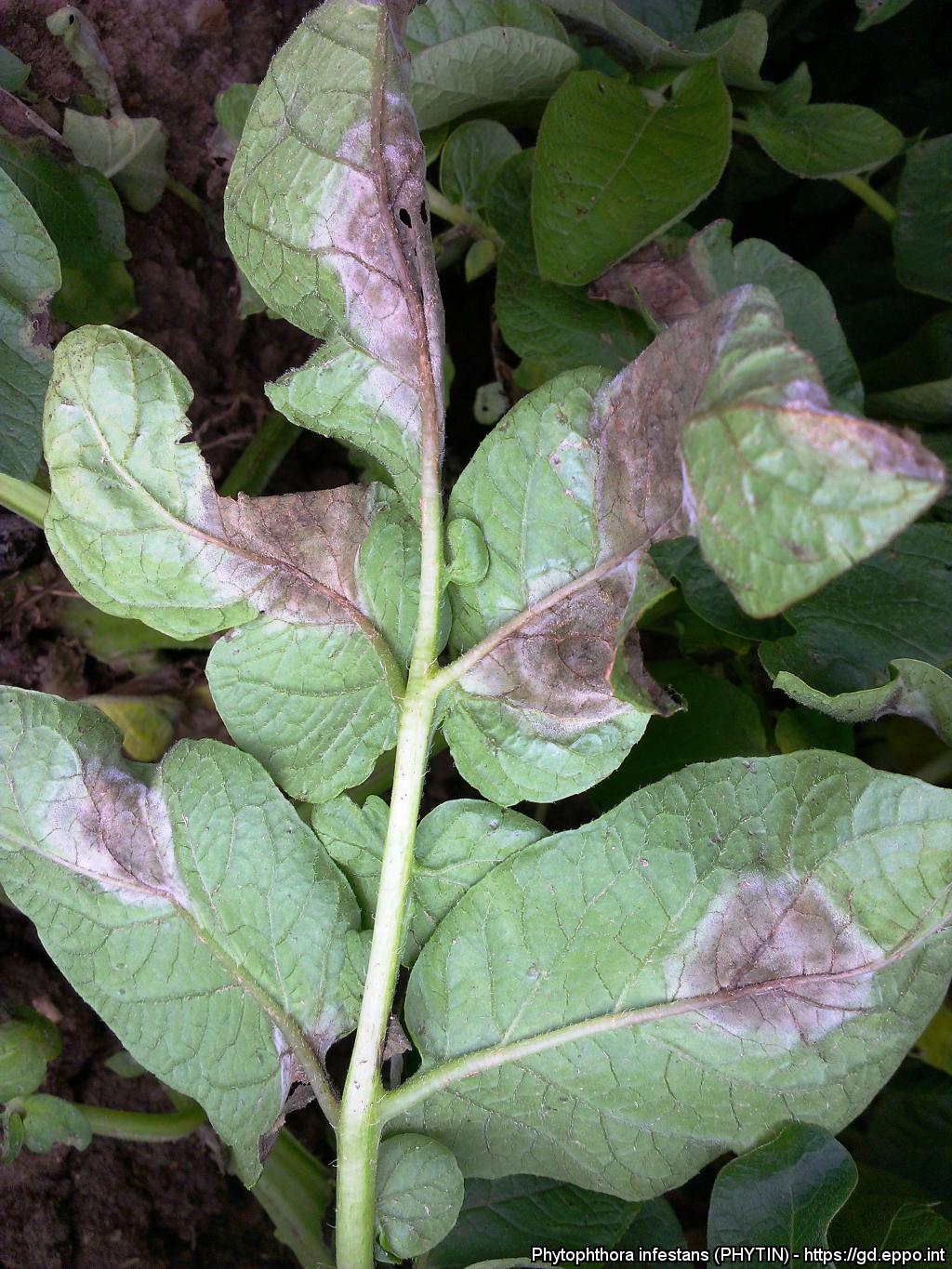
Late blight, caused by Phytophthora infestans, is the most devastating disease of potato worldwide that can cause up to 100% crop loss under disease conducive conditions. The present study was carried out to evaluate and identify effective Trichoderma isolates against the disease. Thirty-nine isolates of Trichoderma spp. isolated at Nepal Plant Disease and Agro Associates (NPDA), Kathmandu from Likhu areas of Nuwakot, Nepal were screened against P. infestans in detached leaf assay for their efficacy in reducing the lesion size of late blight. Fifteen isolates significantly reduced lesion size by 19%–46% compared with the control (water spray). Of them, top 10 isolates along with Sanjeevni (T. viride), a commercial product were tested in field experiments under natural epiphytotic conditions at Thansing and Dhikure of Likhu Rural Municipality in 2020–2021 and 2022–2023 crop years, respectively. The Trichoderma isolates significantly (p < .001) increased plant growth, tuber yield and reduced disease severity in both years. In 2020–2021, isolates, TL1-2A, TL4-81A and TL5-21A reduced disease severity by 37.3%, 37.2% and 30.4%, respectively. The isolate TL1-2A also significantly increased plant height, ground coverage and tuber yield by 41.2%, 30.3% and 72.3%, respectively compared with the control (water spray). In 2022–2023, TL1-2A reduced disease severity by 40.2% and increased tuber yield by 46.4%. Other isolates, though significantly different from control, did not have satisfactory effect on disease control and tuber yield. In both years, the isolate TL1-2A significantly reduced the disease, and increased plant growth and tuber yield.
Thus, TL1-2A isolate can be a potential candidate as a biocontrol agent for the integrated management of potato late blight in Nepal.
Photo: Maria A. Kuznetsova (All-Russian Phytopathology Research Institute), EPPO Global Database. https://gd.eppo.int
Reference: Rokaya, N., Paneru, A., Timila, R. D., Dhital, S. P., Shrestha, R. K., KC, G. B., & Manandhar, H. K. (2023). Evaluation of native isolates of Trichoderma spp. for controlling potato late blight caused by Phytophthora infestans in Nepal. Journal of Phytopathology, 171, 595–603. https://doi.org/10.1111/jph.13214