When plants are healthy, they emit red light that is nearly impossible to see with the naked eye, but with a new instrument developed at York University, it’s now possible to measure that light whether in a lab or out in the field.
Although it may sound like science fiction to say healthy plants glow, this delayed fluorescence comes from light absorbed from the sun, related to photosynthetic activity and health of the plant. Plants emit this glow after they absorb a flash of light.
“We can tell how healthy the plant is by the robustness of the red light they emit. The weaker the light gets, the less healthy the plant is,” says Associate Professor of biophysics Ozzy Mermut of York’s Faculty of Science. “You can’t always tell the health of the plant just by looking at it. Often, it will look green and healthy until you test it.”
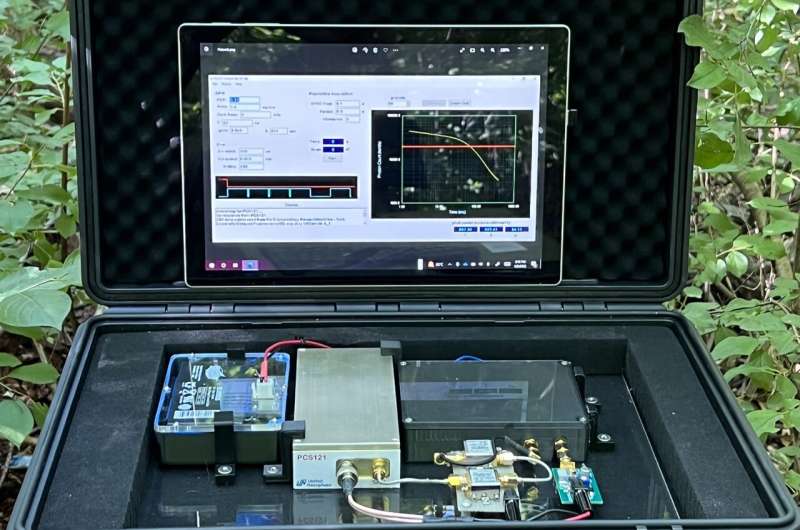
That’s where the new, highly sensitive and portable biosensor Mermut and York chemistry Professor William Pietro engineered comes in. “We developed a device that can capture low intensity light emission from plants,” says Pietro.
The tool, a SiPM (solid-state silicon photomultiplier) -enabled portable delayed fluorescence photon counting device with integrated plug-and-play excitation of a simple LED, can easily be deployed remotely. This enables the device to help measure the health and sustainability of plants, especially those stressed by CO2 emissions, greenhouse gases and extreme weather events, and asses impacts of industrialization. Not only can it be used in a lab but, as it’s the size of a briefcase, it can be easily carried from site to site, whether that’s crops in Saskatchewan, where Mermut hails from, protected Indigenous lands across Canada, or the rainforests of Brazil.
“The results of this can tell us about the reaction of plants under various environmental conditions, including drought, heat and cold shock stress or after floods. It does this in a powerful new way that enables us to study this phenomenon of plant emission directly in the field. It’s so sensitive it can count individual photons, particles of light, emitted from plants,” says Pietro.
This wouldn’t have been possible even a few years ago. The technology was too large, not portable in the least, complicated, and expensive, all of which precluded field-based studies, until now. Mermut and Pietro are hoping other researchers will also start using the instrument in their studies, perhaps to study impacts of climate change over time on plants.In the future, they hope to mount the equipment on a drone so it can fly over rainforests, conservation areas and agricultural fields—which may help farmers address food security—to gauge their health and how it changes over time or in reaction to environmental stressors.
“This is so important because roughly 20 percent of oxygen is produced by the Brazilian rain forests,” says Mermut, who has experience in creating remotely deployable medical devices for global health applications and space life sciences research. “You can imagine how useful such technology may become in the future, not only for plants, but for humans as well.”
The researchers published their proof-of-concept study, “A SiPM-Enabled Portable Delayed Fluorescence Photon Counting Device: Climatic Plant Stress Biosensing” in a special issue of the journal Biosensors—Photonics-Based (Bio-)Sensors for a Healthy Planet.
Already, they are teaching students in the Biophysics undergraduate program in the Department of Physics and Astronomy about the concepts and how to use the research equipment in the MiBAR Lab, where they can simulate the stresses found in nature in greenhouses, to see the effects on various plants.
It’s an example of how cutting-edge research is not only being used right away in the classroom, but also out in the field.