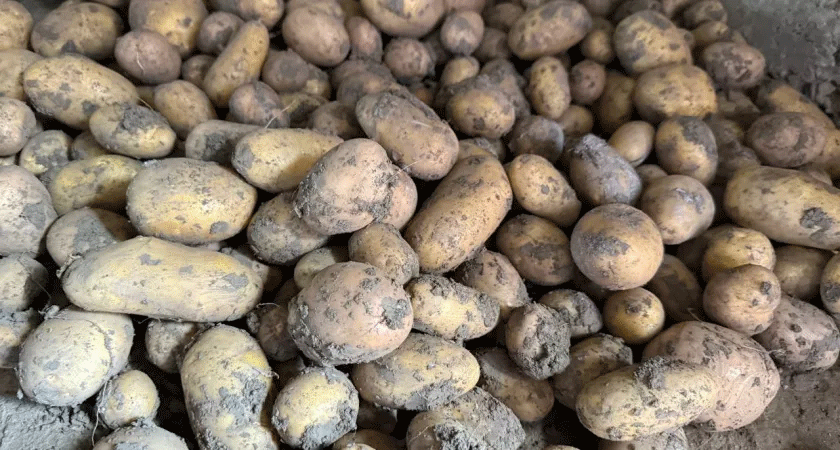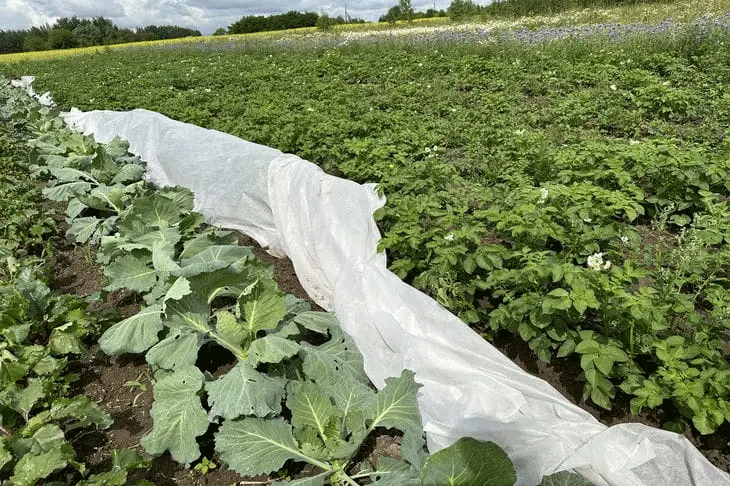
The period following potato harvest presents a critical window for soil management. The soil profile is often depleted of nutrients, particularly potassium, and can harbor residual populations of pathogens like Phytophthora infestans (late blight) and pests such as wireworms (Agriotes spp.). Integrating a fast-growing cover crop, specifically certain mustard varieties (Brassica juncea or Sinapis alba), is a proactive strategy backed by agronomic science. The original text correctly highlights mustard’s multi-faceted benefits: suppression of soil-borne diseases, deterrence of pests, improvement of soil tilth, and contribution of organic matter and nutrients.
Recent research provides a deeper mechanistic understanding of these benefits. The primary mode of action for disease and pest suppression is biofumigation. When mustard biomass is incorporated into the soil and its cells are broken down, glucosinolates within the plant tissues hydrolyze to form volatile isothiocyanates (ITCs). A 2022 review in Applied Soil Ecology confirms that these ITCs have broad-spectrum biocidal activity, suppressing not only fungal pathogens but also nematodes and germinating weed seeds. For wireworms, the effect is more complex; studies suggest the disruption of their habitat and food sources by the dense root system is as impactful as any direct chemical deterrent. Regarding soil health, mustard’s rapid growth (achieving significant biomass in 30-45 days) efficiently captures residual soil nitrogen, preventing leaching, and its deep taproot system helps break up compaction. Upon incorporation, this biomass decomposes, releasing nutrients and increasing soil organic carbon, which enhances water infiltration and retention—a key factor in erosion control mentioned in the source text.
However, optimal results require specific practices. Simply growing and incorporating any mustard is not enough. Research from institutions like the University of California Cooperative Extension emphasizes that biofumigation efficacy depends on variety selection (high glucosinolate cultivars are bred for this purpose), achieving sufficient biomass (at least 3-4 tons per acre fresh weight), and proper incorporation into moist soil to facilitate the chemical reaction. Furthermore, while mustard is an excellent scavenger, it is not a significant nitrogen-fixer; its contribution of N and K comes from the mineralization of its own tissues, essentially recycling existing nutrients.
Incorporating a mustard cover crop post-potato harvest is a scientifically sound and efficient strategy to enhance soil health within a short timeframe. Its value extends beyond simple “green manure” to active biofumigation and physical soil improvement. For farmers and agronomists, the key to maximizing benefits lies in selecting the right mustard variety, ensuring dense growth for adequate biomass, and timing the incorporation correctly. This practice fits seamlessly into integrated pest and soil management programs, reducing reliance on chemical fumigants and fertilizers, breaking pest cycles, and building long-term soil resilience for subsequent crops in the rotation.