The International Potato Tour continues its march across the country’s key agricultural regions. Supported by the general partner, “Avgust” company, and strategic partners “Binom” and “Agrotrade” Group, the expedition has reached the Republic of Tatarstan. The next stop on the map is the village of Narmonka in the Laishevsky District, historically considered the center of vegetable farming in the republic.
Agrofirm “Narmonka” is an enterprise with a special status. Behind the scenes, it is unofficially called “Kazan’s vegetable garden,” because the lion’s share of the “borscht set” (basic vegetables) for the republic’s capital is grown right here. It is a 100% state-owned company that faces not only commercial but also important social tasks.
Storage with an Engineering Approach
The tour of the enterprise began with the heart of any vegetable farm — the potato storage facility. The modern complex, built over the last two years, is designed for the simultaneous storage of 4,000 tons of produce.
As the warehouse engineer explained, loading the storage facility takes about 20 days and happens in late August to early September. The unloading process lasts much longer — about three and a half months, ensuring supplies right up until May. A special feature of the storage here is natural cooling (without the use of refrigeration units) and slatted floors for effective ventilation, which undergo thorough cleaning and disinfection every year before the new season. The main sign of proper storage noted by the tour participants: the warehouse smells exclusively of damp earth, without the slightest hint of rot.
The main and most beloved variety at Narmonka is the famous “Gala”. The potatoes are carefully sorted:
- Large caliber (55+ mm) — goes for food purposes, supplying retail chains and store shelves.
- Medium caliber (40-50 mm) — is sent to budget institutions (schools, kindergartens).
- Small potatoes — are sold for processing (starch) to partners from Chuvashia.
The sorting line uses advanced domestic and foreign equipment (Polish Kmk, Russian “Agrovector” and “Klinmash”). It is noteworthy that even in such an established process, there is always room for optimization. The tour experts shared a life hack with the farm’s engineers: if you strictly divide the tasks among workers at the inspection table (one removes only clods of earth, the second — only cut and rotten tubers, and the third carries out final quality control), the productivity of the line increases by at least 7%, as the staff’s eyes get less “blurred”.
State Buffer and Price Stabilization
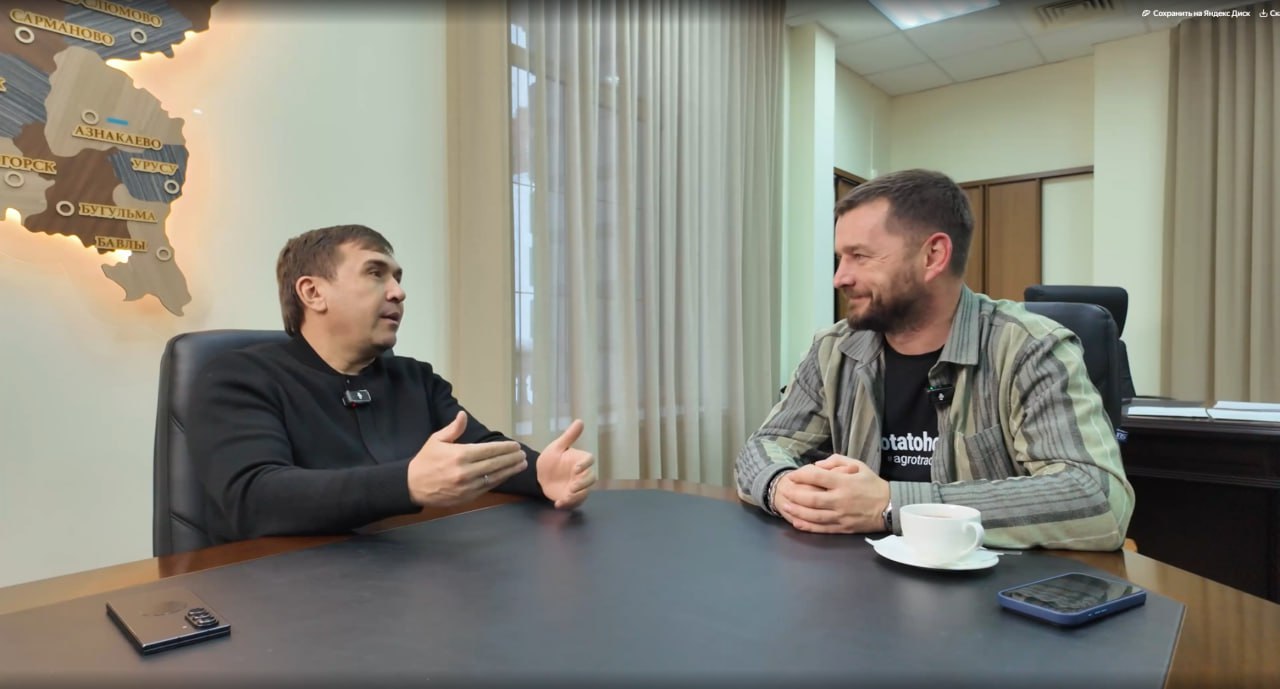
In the second part of the visit, the tour participants spoke with the head of the agrofirm, Rafael Fattakhov, who took charge of the enterprise at the beginning of the year. Prior to this, he served as Deputy Minister of Agriculture of the Republic of Tatarstan for five years.
According to Rafael Fattakhov, the main task of such a state agro-industrial complex is to act as a price buffer in the vegetable market.
“When market prices soar to 50 rubles per kilogram, or when retail chains try to dictate their terms, our enterprise helps maintain the balance,” explains Rafael Fattakhov. “Starting March 14, traditional agricultural fairs will launch in Kazan, Naberezhnye Chelny, and Nizhnekamsk. Out of twenty venues, we will be represented at seven or eight. We maintain the prices recommended by the Ministry of Agriculture, preventing private companies and retail chains from artificially inflating the price tag for the population.”
This year, a new social program is also being launched in Tatarstan through the Consumer Union (Potrebsoyuz): village residents will be given free seed potatoes to grow on their personal plots, and in the autumn, cooperatives will buy the harvest back from them. This will not only provide people with employment but also increase the total volume of potatoes produced in the republic.
National Cuisine and Untapped Potential
In Tatarstan, potatoes are more than just a side dish. It is a strategic product and the foundation of the national cuisine.
“We in Tatarstan generally have no right not to grow potatoes,” smiles the head of the enterprise. “Take echpochmak or kystybyi — almost no dish of ours is complete without potatoes. This is the absolute base of our dining table.”
At the same time, producers see huge potential in product refinement. Currently, the farm mainly sells unwashed potatoes, although the demand for premium (washed and packaged) products is steadily growing. Many third-party entrepreneurs make money by buying farm potatoes, washing them, packaging them, and selling them with a high markup. The agrofirm plans to improve the quality of its own raw materials to actively enter the niche of washed potatoes and, possibly in the future, consider areas of deep processing (for example, the production of potato flakes for export).
A Look into the Future: Robots in the Fields
What awaits potato farming in Tatarstan in 10 years? The management’s answer is unequivocal: total automation.
“Already now, 100% of our potatoes are grown on irrigated lands. But the main problem today is personnel,” summarizes Rafael Fattakhov. “People used to say: let’s build a warehouse, and 15 people will work there. Today we have built the warehouse, but it’s hard to find those 15 people. Therefore, the future lies in minimizing manual labor. I think soon, robot harvesters will be planting and harvesting potatoes. We need to modernize every year to reduce costs and supply high-quality products to the shelves at affordable prices.”
The International Potato Tour leaves the hospitable land of Tatarstan with confidence: as long as engineers who think in terms of efficiency are at the helm, and the storage facilities smell of fresh earth, the food security of the republic is in safe hands. Let’s wish the “Narmonka” agrofirm to enter the field exactly on time and gather an excellent harvest!