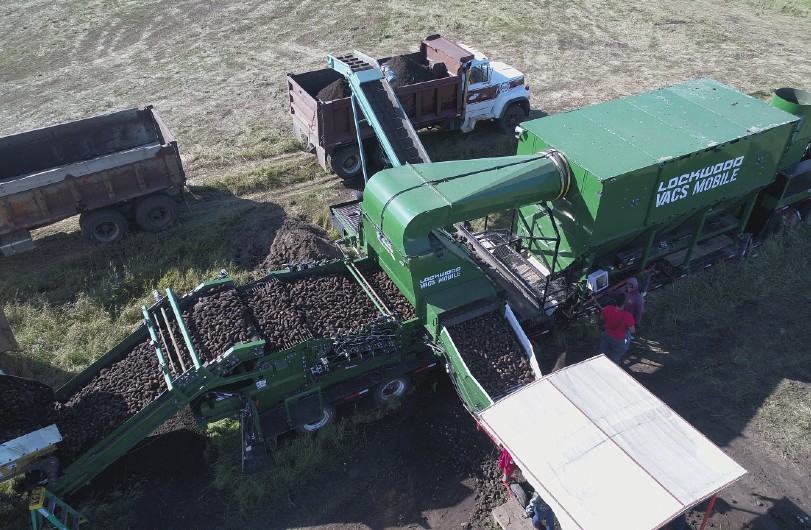
Ask any potato producer where rocks belong and they’ll vehemently tell you: “Not in my field.” While that’s true, they also don’t belong in your yard. Since the very first harvesters dug their way through potato fields some decades ago, farmers have been transporting rocks, dirt and harvest debris back to their storage yards, then either leaving this tare in piles in the yard or driving it back out to the fields.
Neither option is good: yard space is valuable, and the cost of machinery, fuel and man-hours today mean driving tare to and from your yard doesn’t make sense. Industry has responded: in the last couple of years, mobile potato cleaning equipment now allows you to clean potatoes right in the field.
A generation from now, I’d guess we’ll all look back on non-mobile equipment and shake our heads at how unnecessarily time-consuming debris management was before everyone switched to mobile units.
Producers can expect a good mobile unit to clean as well and as efficiently as a fixed-place unit. In many cases, in fact, mobile units do a better, quicker job with far fewer hands than older-style machines.
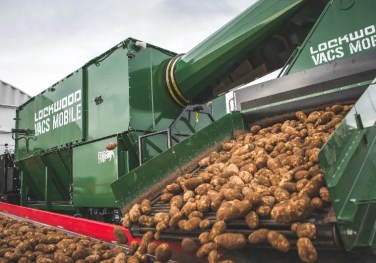
While mobile machines do carry a somewhat higher upfront cost, they return that investment in short order. The biggest and most obvious cost savings is in maximizing transportation efficiency.
Producers moving potatoes from field to storage yard minimize labor and truck runs by moving only the tubers. Producers shipping directly to processing can clean and then ship right from the field, eliminating the extra step of in-yard cleaning without risking penalties for tare.
In addition, keeping dirt, rocks and debris at the field they originated can help reduce disease, weed and pest contamination between fields.
Look for ease of operation when considering your options: the easiest units today offer intuitive, touchscreen control of all hydraulics and one-man, in-minutes set-up and take-down. The Lockwood VACS Mobile is built onto a semi-trailer platform, which means it can be transported at highway speed.
Today’s growers need efficient equipment that can do more with less: equipment that saves time, decreases operator fatigue, and improves functionality. I’m pleased to see the industry stepping up with innovation that works.