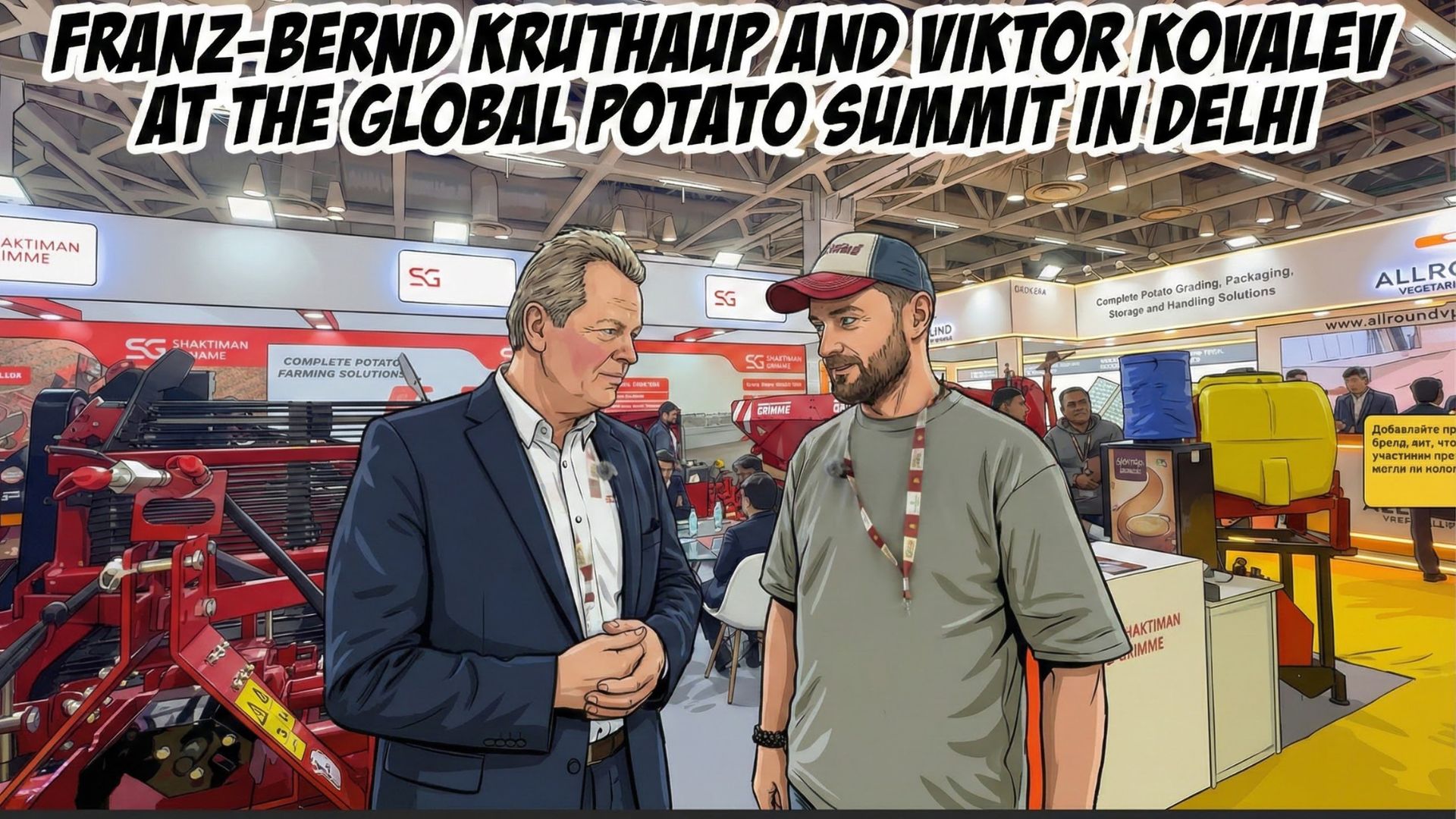
During the International Potato Tour in India, we visited the Indian Potato Summit and spoke at the GRIMME × Shaktiman stand about one of the most practical questions in farm mechanization: Why doesn’t “import the best machines” automatically work — and what has to change for farmers to truly benefit?
The conversation quickly moved from slogans to real-world constraints: tractor horsepower, field size, investment affordability, and service infrastructure. These factors often decide whether mechanization becomes a productivity leap—or remains a “nice idea” that never scales.
From importing machines to building them in India
GRIMME’s first approach in India was to take initial steps independently and try importing machines from Germany. But two challenges emerged immediately:
- Tractors weren’t always powerful enough to operate and pull certain imported machines effectively under Indian conditions.
- The investment barrier was too high for many farmers when the equipment came in as imported technology at imported prices.
This led to a strategic conclusion: long-term success required a manufacturing base in India, with machines adapted to local realities rather than adapted on paper.
That decision aligns with what GRIMME and Shaktiman announced publicly back in 2019: a 50:50 joint venture focused on developing and marketing potato and other root crop machines for the Indian market, combining GRIMME’s technology with Shaktiman’s production capabilities and dealer network. Fructidor+3Shaktiman Farm Machinery+3Grimme+3
Why the “Indian specification” matters
A key point from the discussion is that the equipment developed and produced locally is predominantly designed for Indian requirements—smaller fields, smaller tractors, and specific operational circumstances that must be considered in day-to-day farm work.
This is not a downgrade. It’s engineering discipline: designing for the most common and economically realistic farm setup. GRIMME itself has noted that, within a short time, solutions were introduced that can be operated by tractors in the ~75 hp range—exactly the kind of specification that can unlock adoption in many regions. Grimme+2Profi+2
India as a launchpad for similar markets in Southeast Asia and Africa
Once you design machinery for:
- moderate horsepower tractors,
- diverse soil and harvesting conditions,
- cost-sensitive investment decisions,
…you often end up with solutions that fit many other countries where farm structures and mechanization levels are similar.
That is why the GRIMME × Shaktiman model is not only about India. It also creates a portfolio that can serve Southeast Asia and Africa, where similar constraints exist and where mechanization is expanding rapidly—especially in potato and other root crops. Grimme+2Shaktiman Grimme+2
A message for Central Asia and the South Caucasus
At the end of the interview, we moved from “how it works” to “where it goes next.” International Potato Tour’s 2026 route includes Central Asia and the South Caucasus, and we invited the GRIMME team to connect around real field cases—Kazakhstan, Uzbekistan, Armenia.
The response was encouraging: harvesters are already operating in Uzbekistan and Armenia, and there is interest from additional countries. That’s exactly the kind of practical signal growers and integrators in the region look for: real machines, real farms, real results.
For Central Asia especially, the implication is straightforward: machines engineered for India’s widespread tractor and field realities may prove highly relevant—sometimes even more relevant than equipment built only for large-scale European field systems.
Why this story matters
Mechanization is not just about machines—it’s about fit:
- Fit to tractor power
- Fit to field structure
- Fit to farmer economics
- Fit to after-sales service capacity
The GRIMME × Shaktiman approach demonstrates a model that many emerging potato regions can learn from: local production, localized engineering, and an expansion pathway to other markets with comparable farming conditions.