As part of the International Potato Tour, participants were invited behind the scenes of the research center operated by August. The visit offered a rare look at how crop protection products — both chemical and biological — are actually developed, tested, and validated before reaching farmers’ fields.
For many growers, “research and development” sounds abstract. In reality, it is a highly practical process that combines field expeditions, controlled-environment experiments, laboratory analytics, and long-term biological collections. This tour showed what that looks like in real life.
The Biotron: Simulating Any Climate, Year-Round
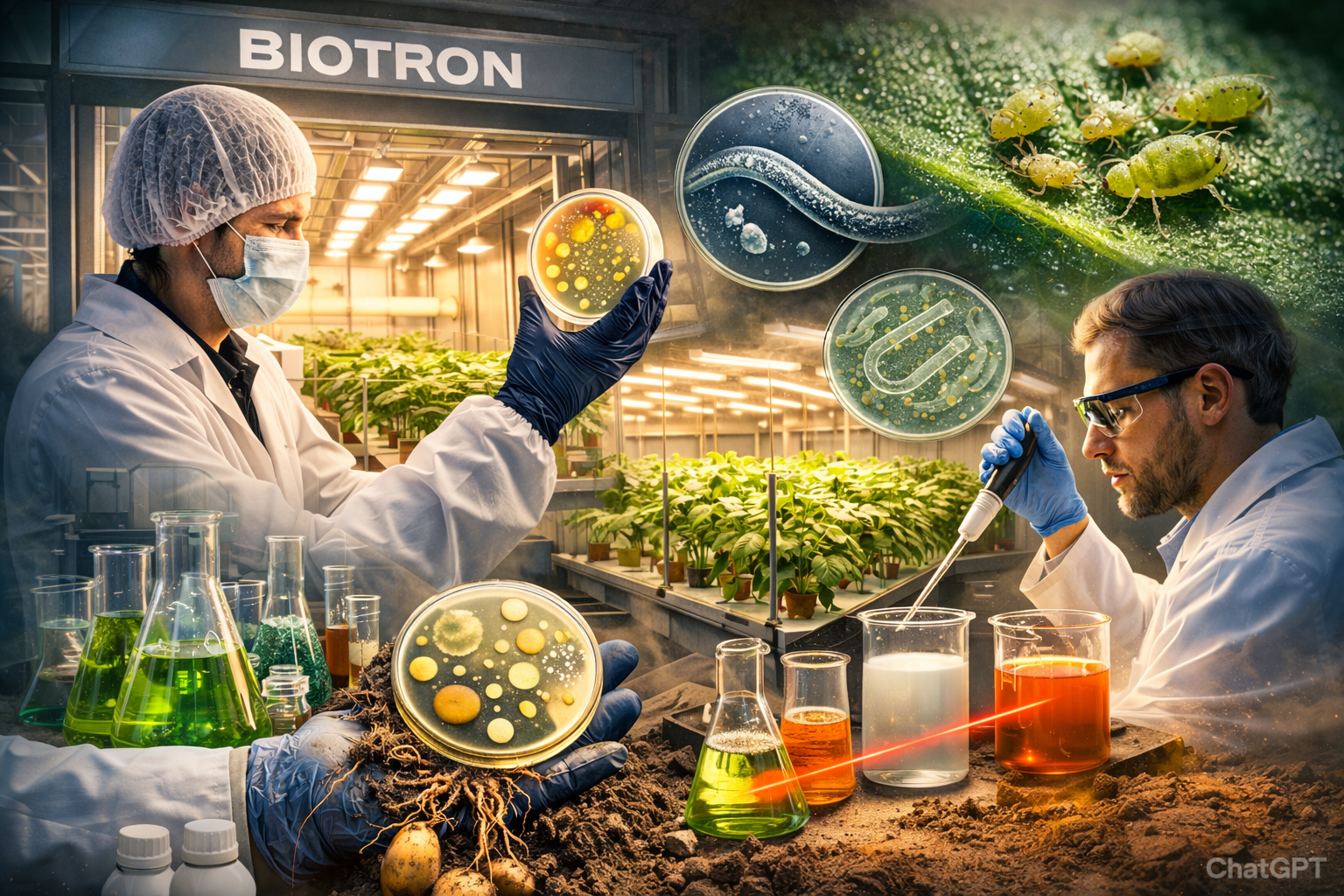
At the heart of the research center is the Biotron — a large climate-controlled complex where plants, insects, and pathogens can be maintained under precisely defined conditions. Temperature, humidity, and light regimes are adjusted to simulate different climate zones, including tropical environments.
This allows researchers to grow crops and weeds all year long and to reproduce disease and pest pressure under controlled conditions. Such facilities are essential for testing how plant protection products perform not only in local climates, but also under stress scenarios that mimic real farming challenges.
From Field Expeditions to the Laboratory
Research does not start in the lab — it starts in the field. Each year, scientists and agronomists travel to regions where disease outbreaks or pest problems have been reported. They collect plant material, soil samples, and insects, which are then brought back to the research center.
There, specialists isolate pure cultures of fungi, bacteria, and other organisms and add them to curated collections. These living libraries make it possible to run standardized tests against real pathogens and pests that farmers face in different regions.
One striking example from the tour was the discovery of a bacterium in the rhizosphere of an apple tree with strong antifungal activity. What started as a random field find is now being studied as a potential foundation for future biological fungicides.
Biological Products Are No Longer a Side Project
Historically, chemical crop protection has dominated the market. But the tour made it clear that biological solutions are becoming a strategic priority. Researchers are developing biological pesticides, insecticides, and microbial fertilizers, aiming to create a full product line based on beneficial microorganisms.
Importantly, biological products are not treated as “marketing add-ons.” They go through the same rigorous screening and testing as chemical products — including efficacy trials against specific pathogens and pests, stability studies, and formulation research.
Working With Real Pests, Not Just Models
Inside specialized rooms, scientists maintain colonies of insects and nematodes that are important agricultural pests. Plants are grown alongside them to ensure realistic host–pest interactions. Environmental conditions are carefully regulated so that both plants and pests develop normally.
This approach matters because the performance of any crop protection product depends on how it works in a living system. Healthy plants host healthy pests — and only under these conditions can researchers properly evaluate how effective a treatment really is.
Why Formulation Quality Matters
One of the most practical demonstrations during the tour focused on formulation quality. Two products with the same active ingredients can behave very differently depending on how they are formulated. Particle size, dispersion, and how well a product dissolves in water directly affect coverage, adhesion to leaves, and ultimately field performance.
Researchers demonstrated how laboratory instruments and simple physical tests (such as light scattering in microemulsions) can reveal whether a product truly matches its declared formulation type. For farmers, this explains why “equivalent” products may deliver very different results in practice.
Data, Not Spreadsheets: Managing Research at Scale
With hundreds of experiments running in parallel across climate chambers and labs, manual tracking is no longer realistic. The research center now uses a digital system that allows regional agronomists and specialists to submit research requests, link them to specific pests, crops, and products, and track progress in real time.
This kind of infrastructure is invisible to farmers — but it plays a major role in turning real-world problems into structured research projects with measurable outcomes.
Why This Matters for Growers
The International Potato Tour showed that modern crop protection is no longer just about choosing between brands. It is about understanding how products are developed, tested, and validated. Behind every registered product are years of field sampling, laboratory trials, formulation research, and biological collections.
For potato growers and agronomists, this transparency builds confidence: effective plant protection starts long before a product reaches the shelf. The more rigorous the science behind it, the more predictable its performance will be in the field.