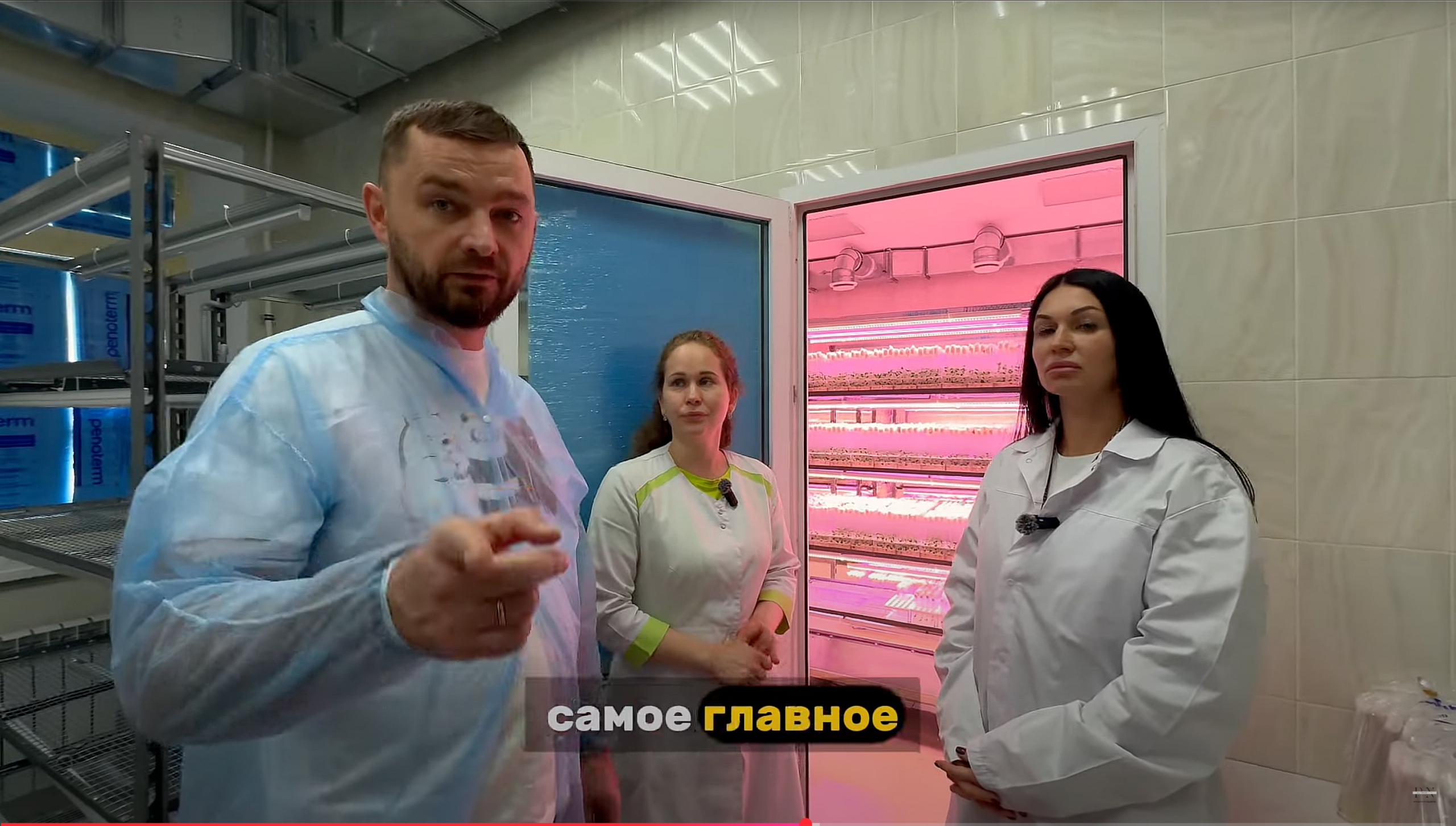
interview recorded during the “Potato Tour of Russia” at the Vesna greenhouse complex (Samarskie Ovoschi Group, Samara Oblast).
In Samara Oblast, the Samarskie Ovoschi Group has built a nearly fully mechanized pipeline for producing mini-tubers from microplants—spanning the lab, greenhouse, and storage. It’s their answer to a tight labor market and rising quality demands for seed material.
A closed loop: lab → greenhouse → mini-tubers → PP-1
- Starting material. Microplants arrive from the Samara Seed Selection Center, which is part of the group.
- Planting. Microplants are set two per 3-liter pot; a 60-meter greenhouse bay holds 15,000 pots (≈ 30,000 plants).
- Fertigation. Each pot has a dedicated 3 L/h drip line; pots are charged with a starter fertilizer (Pidzhemids), with follow-up nutrition delivered via irrigation.
- Storage. A dedicated cold room is reserved for microplants, mini-tubers, and PP-1. In the 2024 season they produced ≈300,000 mini-tubers and about 60 tons of PP-1.
Mechanization: backing domestic equipment
- IRVIN line (Togliatti). Big-bale 5,000 L peat fluffer, peat mixer (water, perlite, and in-house Bacillus-based bio-product), and a carousel for automatic pot filling.
Extras include container and tray washers plus sowing lines for small-seeded crops. - LIS solution (fertigation) units. Programmable dosing from selected tanks; automated irrigation and feeding in the greenhouse.
- Why it matters. In micropropagation, up to ~80% of operations are manual. Automation sharply cuts labor load and human-error risk.
Why they ditched “container cuttings”
Previously 30–40 cuttings went into a single container. If overgrowth/contamination occurred, the entire container had to be discarded. Switching to test-tube (in-vitro) culture lets the lab isolate a problematic plant early—losses are much lower.
Another highlight is the automatic medium dispenser: a single operator prepares ~40 liters/day and dispenses precisely into test tubes, speeding up media prep. Asked about the “secret ingredient,” a lab specialist smiles: “Love.” Still, regimes for light and vitamins are tuned by variety and season—experience has shown even related lines respond differently, and biology keeps its own rhythms.
In-house variety Yunis: profile
- Type: table potato.
- Maturity: mid-season.
- Yield: 50–55 t/ha (with proper agronomy).
- Tuber: oval, yellow skin.
- Agronomic traits: excellent keeping quality, drought tolerance, handles fully mechanized harvest.
- Resistance: to potato wart disease, and to S and M virus groups.
- Plans: first to fully supply their own seed, then sell surpluses.
Calendar and pre-plant prep
Given this year’s weather, planting is slated for the second half of May. Before going to the field, mini-tubers are treated, warmed, and greened (to accumulate solanine and strengthen post-storage immunity). Chitting (“listochka”) is then carried out in the field under cover.
Why this matters for the industry
- People: mechanization helps bridge the skilled-labor gap and stabilizes quality.
- Climate: Yunis stands up to extreme heat in Samara—valuable for southern regions of Russia.
- Import replacement: domestic systems (IRVIN, LIS) demonstrate that key links can be built in-country.
- Process discipline: dedicated drippers, sterile lab practice, and segregated storage underpin predictable hectare-level results.
In their own words
“Automation is the key— it really cuts manual labor.”
“With test tubes, it’s easier: we spot a problem plant and never send it to the greenhouse.”
“In 2024 we produced about 300,000 mini-tubers and around 60 tons of PP-1.”