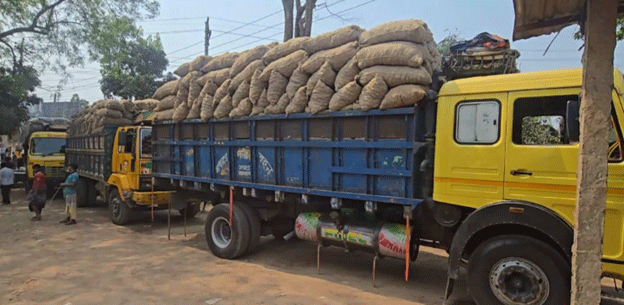
In the heart of Faridpur, Bangladesh, the peak of potato harvesting season has collided with a relentless heatwave, creating a crisis that exposes long-standing vulnerabilities in the country’s cold chain infrastructure. Despite strong yields and painstaking cultivation, many farmers and traders now face post-harvest losses due to insufficient storage capacity and prolonged wait times.
At Faridpur Cold Storage Limited, located in the agricultural hub of Goalchamat, truckloads of potatoes have been idling for days under the blazing sun. The facility, built in 1995 with a capacity of 150,000 bags (around 9,000 metric tonnes), has reached its operational limits, leaving farmers like Selim Mollah, who arrived with 13 tonnes of potatoes from Thakurgaon, anxiously waiting for a slot.
“I’ve been here for five days. The heat is relentless, and I fear my potatoes will be ruined,” Mollah said. His story mirrors that of dozens of farmers queuing along Rajbari Road, where the line of loaded trucks snakes for kilometers in the oppressive heat.
A System Strained by Success
This year’s potato yield has been higher than average, adding stress to already maxed-out facilities. According to Rustum Mollah, manager of Faridpur Cold Storage, over 60,000 bags have been received—most arriving simultaneously from multiple districts including Kushtia, Gopalganj, Nilphamari, and Rangpur. The bottleneck, he explains, is not just spatial but operational.
“Our biggest challenge is manpower,” Mollah said. “With only a limited number of unloading workers, we are struggling to handle the influx. We hope to clear the backlog within four to five days.”
But time is not on the farmers’ side. With ambient temperatures exceeding 35°C (95°F) and rising humidity, potatoes begin to degrade within days of harvest if not kept in optimal conditions. The storage delay threatens not just income, but food security.
The National Cold Chain Deficit
Faridpur’s struggles are symptomatic of a larger, nationwide deficiency in Bangladesh’s agricultural logistics. Despite having over 300 cold storage units with a total capacity of 2.7 million metric tonnes, the system remains critically undersized relative to production volumes.
Bangladesh’s potato production has steadily increased, reaching over 10 million tonnes annually. Yet, less than one-third of that can be securely stored, leading to spoilage, price volatility, and a stifling of export potential.
According to the Bangladesh Agricultural Research Institute (BARI), nearly 30% of perishable agricultural produce is lost post-harvest, costing farmers billions of takas each year. These losses could be significantly reduced through investment in cold storage expansion, decentralization, and cold chain integration.
The Cost of Inaction
Currently, storage costs in Faridpur stand at Tk 405 per 60-kg bag. While this is a reasonable price to secure produce, capacity limits and prioritization issues—often favoring traders over smallholders—are undermining the very purpose of these facilities.
In the face of such constraints, farmers are often forced to sell their produce at distressed prices or let it rot in the field. The psychological toll is just as heavy. “We do everything right—prepare land, buy seeds, manage pests, harvest on time,” said one local farmer. “But in the end, we’re defeated by storage.”
A Call to Modernize
The unfolding situation in Faridpur must serve as a wake-up call for policymakers, investors, and the agricultural industry. Without a robust, decentralized cold chain system, the full potential of Bangladesh’s agriculture will remain unrealized. Strategic investment in modern cold storage facilities, workforce development, and rural access is critical to safeguarding food supplies, empowering farmers, and enabling long-term growth.
For now, the farmers in Faridpur stand in patience—and in peril—hoping their crop survives not only the sun but also the system.