• About Us
  • Partnership & Advertising Opportunities
  • Careers at Potatoes.News
Saturday, January 10, 2026
  • Login
  • Register
No Result
View All Result
POTATOES NEWS
  • NEWS
  • IPT
  • AGROTECHNOLOGY
  • IRRIGATION
  • POTATO PROCESSING
  • Contact us
  • NEWS
  • IPT
  • AGROTECHNOLOGY
  • IRRIGATION
  • POTATO PROCESSING
  • Contact us
No Result
View All Result
POTATOES NEWS

Fusarium Seed Piece Decay and Dry Rot (Fusarium spp.)

by T.G. Lynn
26.11.2022
in AGROTECHNOLOGY
A A
Fusarium Seed Piece Decay and Dry Rot (Fusarium spp.)

Pathogen. Several species of Fusarium are present in most soils. The fungus also survives in infected seed tubers. Fusarium causes seed piece decay, dry rot in storage and plant wilting in the field.

Disease development. Most Fusarium infections occur through wounds and bruises that result from rough handling during harvest, transit or storage. If potatoes are infected at harvest, symptoms are noticeable in storage about a month later. In seed storage facilities where the temperature is below 4°C, tuber lesions do not enlarge, but the fungus remains dormant. As the seed tubers are warmed up in storage or in transit before planting, the fungus will resume growth and the disease will develop rapidly.

Seed pieces infected with dry rot may be partially or completely destroyed in the soil. This results in uneven stands. Single sprouts may emerge from partially infected seed pieces, but the plants are weak and produce few marketable tubers.

Decaying seed pieces are attacked by soft rot bacteria that rot the seed pieces very quickly.
Seed-corn maggots are attracted to decaying seed pieces.
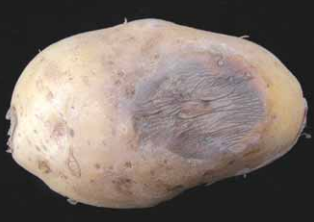
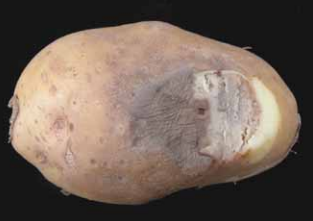
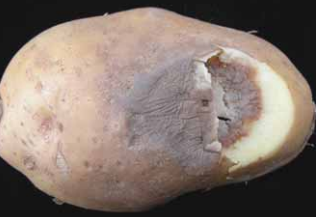
Some Fusarium fungi cause a wet rot. The affected tissue has a jelly-like consistency.
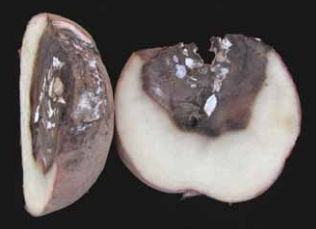
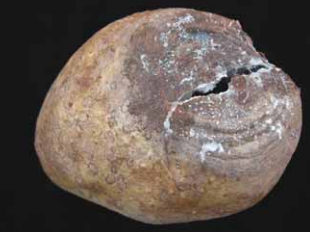
Infected seed pieces. Tufts of white or pink mold develop in infected areas.
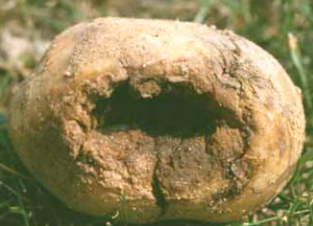
Older lesions are sunken and shriveled, with concentric wrinkles. Cracks often form in infected areas. The rot may involve most of the tuber, resulting in mummification of the entire tuber
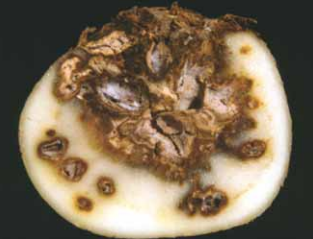
Rotted tissue is brown or grey to black, dry and crumbly. There is no noticeable smell. Cavities lined with white, yellow, pink or blue mold develop in the rotted tissue.
Internal tuber tissue destroyed by Fusarium.
Tags: Dry Rot
Next Post
Rhizoctonia (Rhizoctonia solani)

Rhizoctonia (Rhizoctonia solani)

General Partner’s position

Recommended

kids at farm

Kids at farm – working from home

5 years ago
From Cosmetic Reject to Value Stream: The Business Case for “Imperfect” Produce

From Cosmetic Reject to Value Stream: The Business Case for “Imperfect” Produce

3 months ago
  • About Us
  • Partnership & Advertising Opportunities
  • Careers at Potatoes.News

© 2010-2026 POTATOES NEWS

Welcome Back!

Login to your account below

Forgotten Password? Sign Up

Create New Account!

Fill the forms below to register

All fields are required. Log In

Retrieve your password

Please enter your username or email address to reset your password.

Log In
No Result
View All Result
  • NEWS
  • IPT
  • AGROTECHNOLOGY
  • IRRIGATION
  • POTATO PROCESSING
  • Contact us

© 2010-2026 POTATOES NEWS