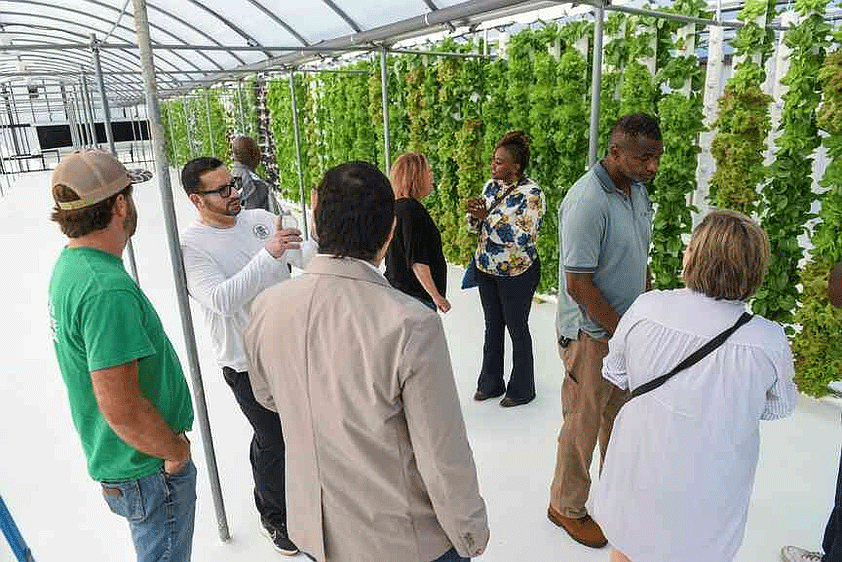
A groundbreaking research initiative in Arkansas is taking direct aim at a critical frontier for controlled-environment agriculture (CEA): moving beyond leafy greens and herbs to cultivate caloric staple crops. The University of Arkansas at Monticello (UAM) has secured a $100,000 grant to optimize potato and rice cultivation using proprietary vertical farming technology. This project, “Optimizing Potato and Rice Cultivation in Vertical Farms Using 180 Pipe Technology,” represents a strategic investment in solving the scalability and nutritional output challenges of vertical farming.
While the global vertical farming market is projected to grow from $5.1 billion in 2023 to over $20 billion by 2029, its focus has been largely limited to high-value, fast-growing leafy greens. Staple crops like potatoes and rice present a vastly different set of agronomic and economic hurdles, including space-efficient architecture for tuber formation, energy-efficient lighting for longer growth cycles, and breeding for compact, high-yielding phenotypes. Successfully adapting these crops could dramatically expand CEA’s role in food security. For context, rice feeds over half the world’s population, and potatoes are the third most important food crop globally. Making them viable in vertical systems would localize production of these staples, potentially insulating supply chains from climate volatility—a significant concern as traditional potato yields are projected to decline in many regions due to increasing heat stress.
The UAM project, hosted at the 180 Pipe facility in Sheridan, is notably applied and collaborative, emphasizing hands-on student involvement and direct ties to the state’s agricultural economy. This practical focus is essential for bridging the “valley of death” between research and commercial adoption in ag-tech. The grant period (July 2025 – June 2026) will fund critical data collection on variables like yield per cubic foot, energy and water use efficiency, and ideal nutrient formulations for tubers and grains in a stacked system. As Dr. Arturo Quintero Ferrer, the lead researcher, notes, the work simultaneously trains the next-generation agri-tech workforce—a pressing need as the industry faces a significant skills gap. This model of integrating R&D with workforce development mirrors successful approaches seen in other states investing in agri-tech innovation hubs.
The UAM vertical farming grant is more than a local research project; it is a microcosm of the broader evolution in CEA. By targeting globally significant staple crops, Arkansas is contributing to answering the pivotal question for the vertical farming industry: can it graduate from producing premium salads to producing meaningful calories? The success of such applied, industry-linked research will hinge on delivering hard data on economic viability—specifically, whether the yield density and premium value (e.g., for ultra-local, pesticide-free staple crops) can justify the capital and operational expenditures. If proven viable, vertically farmed potatoes and rice could open new markets for urban and peri-urban food production, enhance regional resilience, and provide a new tool for producers seeking to diversify and de-risk their operations in an era of climatic uncertainty.