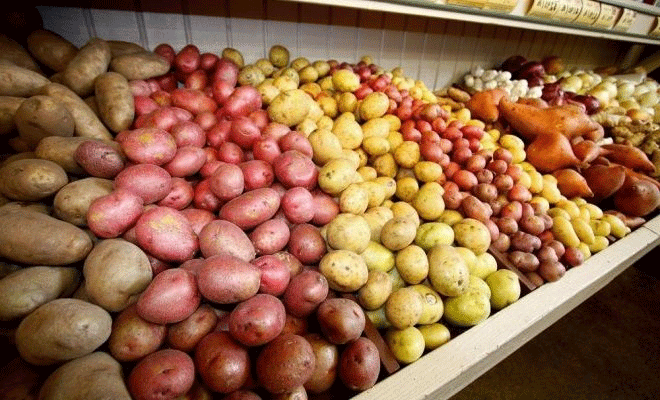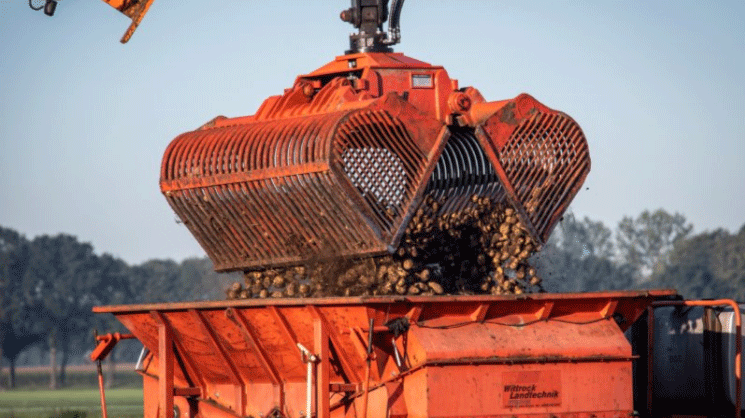
European potato starch producers are navigating a season of plenty that presents a complex set of challenges. Driven by a significant ~10% expansion in cultivation area across Europe—with notable growth in Germany—coupled with favorable agronomic conditions, the 2023/24 harvest has delivered both early maturity and exceptionally high yields. In the Netherlands, starch yields have reached 12-13 tons per hectare in some cases, a testament to advanced cultivar performance and high dry matter content averaging 20-20.5%. While this bounty ensures full utilization of processing capacity, with cooperative giant Avebe extending its campaign from mid-February to at least mid-March, it has simultaneously triggered significant market pressure. The core issue is a classic supply-demand imbalance: while the EU’s demand for native starch remains relatively stable at around 1.6 million tonnes annually, a sudden supply spike directly erodes prices in the highly competitive bulk commodity segment.
This market dynamic has forced a critical strategic reckoning. Avebe’s CEO, David Fousert, has explicitly stated that the cooperative’s future lies in “value, not tons.” This reflects a broader industry imperative to shift from commodity dependence to specialization in high-value, differentiated applications. The commitment to accept all contracted (A), optional (B), and even non-contracted (C) volumes from member growers underscores a cooperative ethos but also highlights the immediate burden of surplus. The strategy forward is to accelerate development in premium markets such as plant-based proteins, texturizers, and bio-based materials, which offer better margins and insulation from volatile bulk starch prices. This pivot requires close collaboration across the chain: growers must focus on quality parameters and contract alignment, while processors and scientists must drive innovation in product functionality and new applications to create sustainable demand pull.
The current European potato starch landscape is a powerful case study in modern agricultural volatility, where production success does not automatically translate to economic resilience. Record yields, while an agronomic triumph, have exposed the sector’s vulnerability to commodity market forces. The path to stability lies in a coordinated, value-chain-wide commitment to de-commoditization. For farmers and agronomists, this means engaging in contracts that reward quality and specific traits over sheer volume. For processors and researchers, the mandate is to innovate and capture value in specialized, growing market niches. Ultimately, navigating this paradox requires moving beyond a mindset of maximizing harvest to one of maximizing value, ensuring the entire chain thrives even in seasons of abundance.