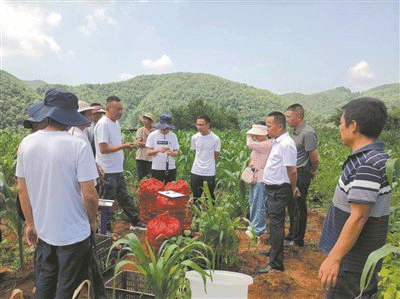
A remarkable agricultural transformation is underway in Nayong County, Guizhou Province. Where local potato farmers once harvested 15,000 to 18,750 kg per hectare (1,000-1,250 kg/mu) using traditional methods, the 2024 season yielded a groundbreaking average of 37,500 kg/ha (2,500 kg/mu). This 100-150% increase, achieved on five pilot villages in Kunzhai Township, was not a stroke of luck but the result of a meticulously executed scientific farming protocol. The program, led by the Hebei Provincial Committee of the Revolutionary Committee of the Chinese Kuomintang, provides a powerful blueprint for bridging the yield gap in smallholder systems globally.
The success stemmed from a systems-based approach that moved far beyond simply introducing a new variety. The cornerstone was comprehensive soil fertility testing, which identified local acidity and nutrient deficiencies. Technicians then crafted a customized fertilization plan, blending compound fertilizer with matured farmyard manure to optimize nutrient supply while improving soil structure and preventing compaction—a critical step for tuber development. Precision planting ensured optimal plant spacing for light and nutrient access. Furthermore, the strategy incorporated Integrated Pest Management (IPM), using biological and physical controls aligned with pest lifecycles to minimize pesticide use. This “technology follows the seed” philosophy ensured the improved variety’s genetics could express their full potential. The results speak volumes: a commercial-grade rate exceeding 85%, selling at nearly double the price of traditional potatoes, boosting farmer income by approximately $7,000 USD per hectare.
This case aligns with and is reinforced by global data. The Food and Agriculture Organization (FAO) consistently identifies improved seed varieties and soil health management as primary drivers of sustainable yield increases. A 2023 report in Nature Food emphasized that closing yield gaps in root and tuber crops often depends more on agronomic practices than genetic improvement alone. The program’s focus on creating “new farmers” through field-based training addresses a universal barrier: knowledge transfer. This focus on human capacity, alongside plans to scale to 200 acres under an “association + cooperative + farmer” model, shifts the paradigm from aid to self-sustaining agricultural innovation.
The Nayong potato project demonstrates that dramatic yield and income improvements are achievable when scientific agronomy is applied holistically and taught participatively. It validates that the core challenges—poor soil health, suboptimal crop management, and knowledge gaps—are solvable through targeted, site-specific interventions. The most significant outcome is not the impressive 2024 harvest data, but the cultivation of local expertise, creating a “technology team that never leaves.” For agronomists and development practitioners worldwide, this case underscores that sustainable intensification begins with understanding the soil, supporting the farmer with precise knowledge, and building systems that allow proven science to take root at the local level.