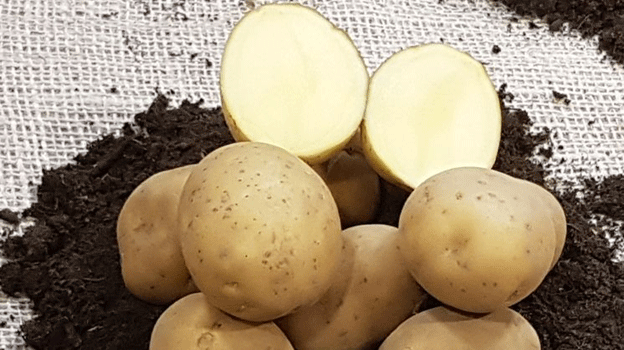
Potatoes feed more than 1.3 billion people globally, yet breeding improvements have been surprisingly limited over the past century. Many of the most widely grown potato varieties today—such as Russet Burbank, dating back to 1908—were developed decades ago. Why has progress been so slow in such a critical crop?
The answer lies in the potato’s complex genetic structure. Unlike many other crops, the cultivated potato is tetraploid, meaning each cell contains four copies of every chromosome instead of the usual two. This makes traditional crossbreeding slow, imprecise, and difficult to control.
Now, a joint research team led by Prof. Korbinian Schneeberger from LMU Munich and the Max Planck Institute for Plant Breeding Research, in collaboration with Wageningen University, the Leibniz Institute (IPK), and Xi’an Jiaotong University, has achieved a significant scientific milestone. They have successfully reconstructed the genomes of ten historical European potato varieties, some dating back to the 18th century. Their findings were published in the prestigious journal Nature.
Surprising Results: A Narrow Genetic Pool
The study revealed that these ten varieties already contain 85% of the genetic variability present in all modern cultivated potatoes in Europe. This surprising uniformity is the result of genetic bottlenecks. After potatoes were introduced from South America to Europe in the 16th century, only a few varieties adapted to European conditions. Over time, diseases like late blight (Phytophthora infestans) further reduced the gene pool, culminating in devastating events such as the Irish Potato Famine in the 1840s.
Despite this low overall diversity, researchers found that when differences do occur between chromosomes, they can be massive—as much as 20 times greater than those seen between human chromosomes. This deep divergence is believed to be rooted in pre-European domestication practices by indigenous peoples in South America, who began cultivating and hybridizing potatoes over 10,000 years ago, including with wild relatives.
A New Method to Analyze Thousands of Potato Varieties
One of the study’s most impactful outcomes is a new, efficient genomic analysis method. Instead of sequencing each variety from scratch—a costly and time-consuming process—researchers can now compare readily obtainable DNA fragments to the ten reconstructed reference genomes. This technique was successfully tested on Russet Burbank, a variety still used globally in French fry production.
This streamlined approach could unlock insights from the approximately 2,000 potato varieties registered in the EU, speeding up breeding projects and enhancing resilience traits like disease resistance and climate tolerance.
According to the International Potato Center (CIP), improving potato breeding is essential as climate change intensifies and global demand for processed products continues to rise. With access to detailed genome data, breeders can finally harness tools like marker-assisted selection and CRISPR gene editing with greater precision and confidence.
By decoding the genomes of historical potato varieties, scientists have delivered a transformative resource for global agriculture. Their findings not only highlight the potato’s untapped genetic potential but also provide an efficient toolset to unlock it. For breeders, agronomists, and farmers, this signals the start of a new era—where innovation meets tradition, and one of the world’s oldest crops gains a powerful edge for the future.