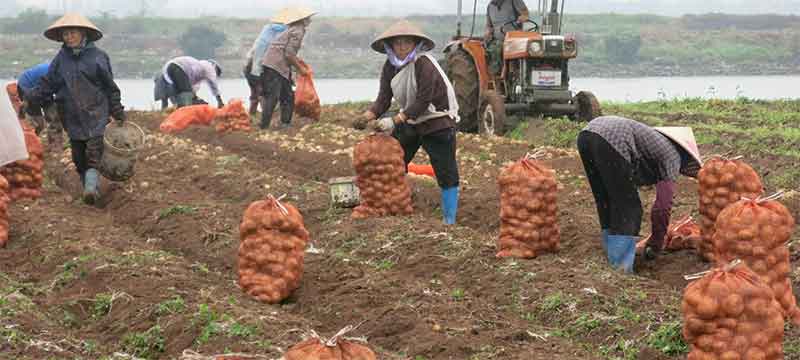
Farmers in the coastal districts of Haiphong City, Vietnam, are in the midst of a bustling winter potato harvest for the 2025-2026 season, reporting excellent yields and favorable prices. A key driver of this success is the widespread adoption of contract farming, where companies guarantee the purchase of the entire harvest at stable prices. In Hong Chau commune alone, over ten households have planted more than 20 hectares, with farmers like Vu Thi Thanh harvesting over 900 kg per “sao” (360 sq m). This partnership model provides farmers with peace of mind, allowing them to focus on production without worrying about market fluctuations. Similar scenes of abundant harvests and high-quality tubers are reported in eastern communes such as Quyet Thang, Tien Lang, and Vinh Bao, where farmers have been collecting their crops since early Lunar New Year.
According to the Haiphong Department of Crop Production and Plant Protection, approximately 850 hectares have been planted with winter potatoes this season, with 12 integrated production models covering over 250 hectares. Favorable weather and the synchronized application of mechanization have boosted yields on these contracted plots to 1.2–1.4 tons per sao—50-100 kg higher than traditional methods. With purchase prices at 8,500 VND/kg or more, farmers are earning an average profit of 4-5 million VND per sao per crop. However, challenges remain in expanding production, including the conversion of agricultural land for construction, the dissolution or weak operation of some cooperatives, and the hesitation of some farmers to shift from small-scale to concentrated commercial farming. In response, companies like Golden Agricultural Development Joint Stock Company are actively collaborating with farmers, providing seeds, materials, technical advice, and full mechanization support to enhance productivity and reduce costs. Local authorities are also stepping in to plan concentrated production zones, facilitate contracts, and protect farmers’ interests, viewing this integrated model as a crucial step toward transforming agriculture into a stable, sustainable, and value-chain-oriented sector.