In 2024, West Bengal—India’s second-largest potato-producing state—anticipated a record harvest of 14 million tonnes, yet its farmers are staring down one of the most economically distressing seasons in recent years. From Bankura to Hooghly, growers are battling not bad weather or pests, but low procurement prices, poor policy implementation, and rising input costs.
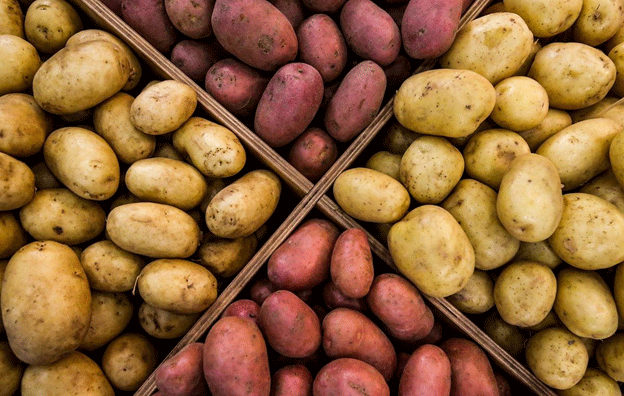
This year’s harvest should have brought relief. Instead, it has intensified despair. Farmers report market prices for Pokhraj potatoes as low as ₹550 per quintal (approx. $6.63 per 100 kg)—well below the production cost.
“We can’t recover even our basic expenses,” said Samir Bhandari, a farmer from Bankura. “We’ve been harvesting Pokhraj potatoes since January, but we’re selling at a loss.”
Production vs. Profit: The Crisis in Numbers
West Bengal, which typically produces 9–10 million tonnes of potatoes annually, exceeded expectations this year due to favorable weather conditions. The state’s key potato-producing districts—Hooghly, Bardhaman, and Bankura—reported high yields, particularly for the Jyoti variety, the most widely grown.
But success in the fields hasn’t translated to earnings.
- The cost of cultivation is estimated at ₹30,000–33,000 per bigha (approx. $361–$398).
- The government’s announced Minimum Support Price (MSP) is ₹900 per quintal (approx. $10.84 per 100 kg)—which many farmers argue is too low to cover rising seed and fertilizer costs.
- In reality, market prices have hovered closer to ₹550–₹700 per quintal, pushing growers into substantial financial losses.
Adding to their woes, agricultural laborers are not being paid on time, deepening the economic strain across rural communities.
Procurement Delays and Policy Gaps
To stabilize the market, the West Bengal government committed to procuring 1.1 million tonnes of Jyoti potatoes through cold storage facilities in March. However, as of early March, implementation remained unclear.
Prasenjit Chatterjee, a cold storage operator in Bankura, noted: “We’ve received no detailed instructions. Farmers are showing up, but we can’t proceed without clarity from the authorities.”
Even worse, many potato growers—especially sharecroppers without land documentation—are ineligible to participate in the procurement program. As a result, they’re forced to sell to private traders at significantly lower prices.
Input Costs Surge, Support Systems Decline
Farmers also report a sharp increase in input prices:
- Seed potatoes and fertilizers are often unavailable through formal channels, pushing farmers to the black market where prices are inflated.
- Cooperative credit societies, once a reliable source of agricultural loans, are largely non-functional.
- Many farmers now turn to microfinance institutions, which charge higher interest rates, increasing the debt burden.
“The cost of cultivation has gone up, but the price of the produce has come down,” said Utpal Ray, a farmer from Hooghly. “Why has the procurement price not kept up?”
Policy Must Match Production
The crisis facing potato farmers in West Bengal underscores a broader systemic challenge: agricultural policy that fails to align with on-ground realities. Despite favorable growing conditions and a bumper crop, inadequate pricing mechanisms, bureaucratic delays, and exclusionary policies have left farmers vulnerable.
To protect farmer incomes and stabilize markets, policymakers must:
- Reassess the MSP for potatoes based on real input costs
- Simplify procurement participation, especially for sharecroppers
- Improve coordination with cold storage facilities
- Revive cooperative credit systems
- Expand export channels to offload surplus and boost returns
Without such measures, the cycle of overproduction and undercompensation will continue—draining the lifeblood from one of India’s most vital agricultural sectors.