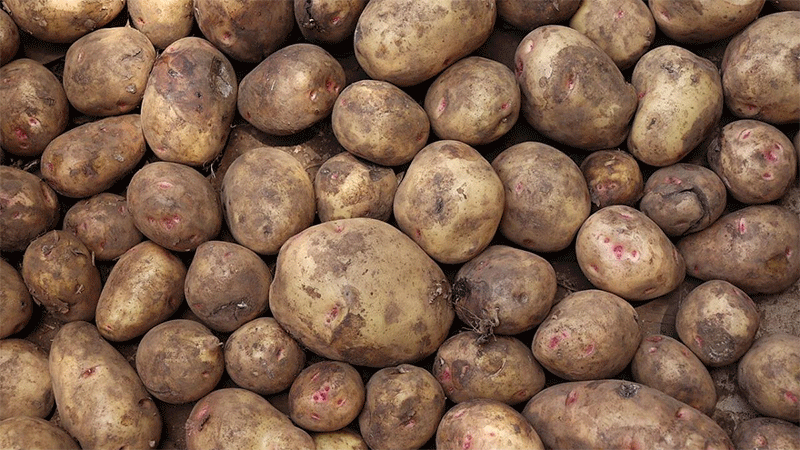
Recent field trials conducted by researchers at the St. Petersburg Federal Research Center of the Russian Academy of Sciences (SPC RAS) provide compelling, data-driven evidence for the agronomic and economic value of drone technology. In a season with 200% of average monthly precipitation, ground-based sprayers were rendered completely useless, unable to access fields without causing severe soil compaction and damage. The result was a total crop loss in control plots, where plants “completely blackened and rotted.” In stark contrast, adjacent plots treated by an integrated drone system—comprising a scouting UAV, a spraying agrodrone, and autonomous flight software—remained healthy, exhibiting only localized disease. The outcome was a measurable 9% increase in yield on the drone-treated experimental plots.
This success underscores a critical shift: drones are transitioning from novel gadgets to essential components of a resilient farm management system. The SPC RAS model operates on a three-pillar framework of precision agriculture:
-
Diagnostic Monitoring: Aerial photography and multispectral imaging create detailed maps of soil moisture, early disease foci, and weed pressure.
-
Targeted Application: Spraying drones apply plant protection products with centimeter-level accuracy, enabling variable-rate application that can reduce chemical use by 15-30% according to broader industry analyses.
-
Crop Management: The system facilitates operations like desiccation, ensuring uniform maturity and harvest timing.
The comparative advantages are clear. While traditional tractor-based sprayers average 5-7 gallons of fuel per hour and are confined to optimal soil conditions, electric drones operate with minimal soil impact and can deploy within short weather windows, a capability increasingly vital as climate change increases the frequency of extreme rainfall events. A 2023 report by the Association for Unmanned Vehicle Systems International (AUVSI) projected that drone-enabled precision agriculture could create an economic impact of over $4 billion annually in the United States alone, primarily through input savings and yield preservation.
For farm businesses of all scales, the path to adoption is becoming more accessible. While initial investment for a professional-grade spraying drone system can range from $15,000 to $40,000, a growing service sector offers rental and “UAV-as-a-Service” models, allowing farmers to trial the technology without major capital expenditure. The return on investment is accelerated by the direct savings on fuel, labor, and inputs, combined with the prevented losses from untreatable disease or pest pressure.
The evidence is conclusive: drone technology in agriculture has matured beyond proof-of-concept. The 9% yield increase documented by SPC RAS is a significant figure in an industry where profit margins are often narrow, but the greater value lies in risk mitigation and operational sovereignty. By providing a reliable, all-weather application method, drones transform weather from a master variable into a managed parameter. For forward-thinking farmers, agronomists, and engineers, integrating UAVs is no longer about keeping pace with a trend; it is a strategic decision to future-proof operations, enhance sustainability through precise input use, and secure profitability in an increasingly unpredictable climate. The fields of the future will be monitored and managed from the air, ensuring that crops stand resilient, come rain or shine.