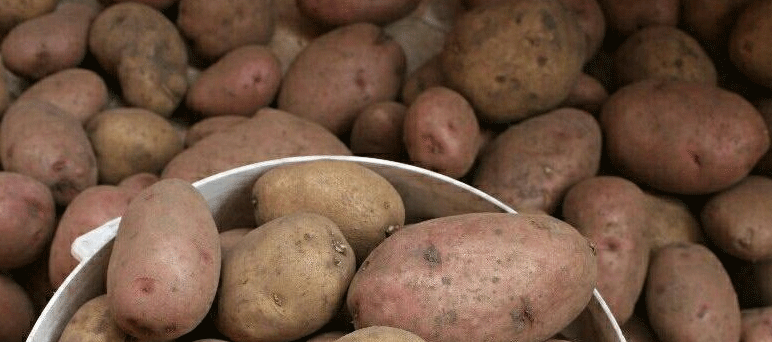
In the remote settlement of Turukhansk, located in Russia’s Krasnoyarsk Krai within the Arctic Circle, local authorities recently levied significant fines against three retailers for excessive price markups on staple foods. Inspections by Rospotrebnadzor, the Russian consumer protection agency, found markups dramatically exceeding the legally mandated maximum of 35% for consumer goods in Far North territories. Specific violations included potatoes sold with a 200% markup, onions at 150%, and carrots at 180%. Each business owner was fined 50,000 rubles (approximately $550 USD) under Article 14.6 of the Code of Administrative Offenses for unjustified price increases on essential commodities. This enforcement action highlights the persistent tension between market forces and consumer protection in remote, high-cost regions.
While the penalties address clear legal violations, the underlying issue is a profound logistical and agricultural challenge. Turukhansk is emblematic of “food desert” conditions exacerbated by extreme geography. The cost of transporting fresh produce over vast distances—often via seasonal ice roads or expensive air freight—creates a high baseline cost. A 2023 World Bank report on logistics in the Arctic Circle notes that transportation costs can be 3-5 times higher than in temperate regions, directly impacting shelf prices. The absence of local, protected agriculture or season-extension technologies for staples like potatoes and root vegetables leaves communities wholly dependent on fragile supply chains. This creates an environment where scarcity, whether real or perceived, can lead to exploitative pricing, as retailers may seek to offset their own high costs and risks or capitalize on a captive market.
The situation in Turukhansk is more than a simple case of regulatory non-compliance; it is a symptom of a fragile food system at its geographical limit. While enforcement of price caps is necessary to prevent immediate consumer exploitation, it is a reactive, short-term solution. A sustainable long-term strategy must look upstream. For agricultural professionals, this case underscores a critical niche: advancing technologies for controlled environment agriculture (CEA), such as insulated greenhouses, hydroponics, or container farming, tailored for Arctic conditions. Developing localized, resilient food production capabilities for calorie-dense staples could reduce import dependence, stabilize prices, and enhance food security. Ultimately, ensuring fair access to nutritious food in the world’s most remote communities will depend less on policing markups and more on innovating and investing in hyper-local agricultural solutions that can thrive against the odds.